



By Salamat Ali Khan
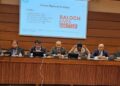
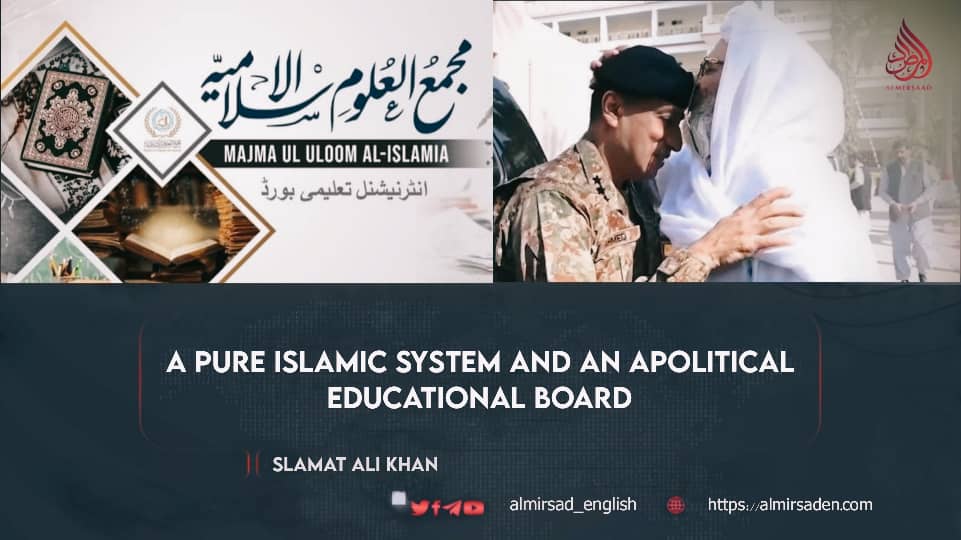
A prominent institution in Pakistan is currently holding a gathering under the name Fuzala Ijtema (Scholars’ Gathering). This seminary proudly asserts its religious legitimacy and frequently boasts of both the number and the caliber of its graduates. According to its administrators, this annual event is a unique practice. They gather their alumni, provide guidance on discipline, conduct, and administrative responsibilities, listen to their reports concerning religious identity, scholarly stature, and practical efforts, and also allow the attendees to speak.
Traditionally, the gathering has always had distinctive features compared to other religious institutions. Yet this year, there is an unusually loud commotion. The focus on religious and scholarly credentials appears diminished, while attention to foreign policy and interference in the affairs of others has noticeably increased. Instead of true scholars, the main guests now include military figures, political personalities, and people with religious lineage, individuals who are routinely described as being linked to intelligence agencies, the establishment, and similar power structures. Their speeches and writings overflow with praise for these covert organizations.
It is important to note that this institution, Jamia al-Rasheed, was founded by the late Mufti Rashid Ahmed. Its current rector is Mufti Abdul Rahim, and many stories circulate about him. One of these accounts, narrated by Karachi’s noted scholar Mufti Ahmad Mumtaz, is widely known among ordinary people and insiders alike. Several notable members of the institution allege that when the foundation of Mullah Umar Mosque was laid in Kandahar on the site of a former cinema, Mufti Abdul Rahim issued fundraising appeals in its name and then quietly appropriated a substantial sum. According to them, generous donations poured in from Muslims around the world, yet instead of using the funds as declared, he allegedly established, under the seminary’s banner, an institution aimed at serving soldiers and others in military attire.
Some former affiliates cite their complete severance of ties with the Jamia due to the total deviation of its current head from the instructions of the founder. According to them, this enforced divergence, dictated by the administrator, was utterly intolerable, leaving them no choice but to cut ties.
Setting these matters aside, the most important point is the institution’s decision three years ago to withdraw from Pakistan’s major examination board, Wifaq-ul-Madaris, and establish its own board named Majma. This move was approved by influential circles of that period.
Whenever people asked why they sought to break away from Wifaq-ul-Madaris, they consistently offered two explanations.
The first was that they wanted to incorporate modern education into the curriculum but Wifaq refused. The second, repeated almost daily on their media platforms, was that Wifaq had allegedly strayed from its principles, for its constitution explicitly states that it will neither fall under the patronage of any political party nor become part of any political agenda. In reality, however, Wifaq functions entirely under the shadow of the religious-political group Jamiat Ulema-e-Islam, particularly under Maulana Faazl-ur-Rehman.
Bearing these claims in mind, when I watched today’s gathering, I was astonished at how openly the institution mocked its own justifications and trampled its declared principles underfoot, or rather crushed them beneath military boots. Their grievance had been that Wifaq succumbed to political influence, yet here before their own graduates sat the Governor of Sindh, the Army’s spokesperson, and political brokers whose involvement in power networks is no secret.
Within this religious seminary, the graduates were then instructed on one of the most delicate and complex domains of governance: foreign policy. I found myself wondering how people can show so little dignity toward their own words, how they can look upon their own arguments without the slightest sense of honor. What sort of people are these, who may or may not feel shame before Allah, yet do not even feel shame before the public?
During the gathering, one graduate proudly recounted that he had asked the DG ISPR why an Islamic system had not been implemented in Pakistan for more than seventy years. According to him, the DG replied, “Which Islam are you referring to? The one enforced in the neighboring country? If that is what you mean, then even two hundred and fifty years from now it will never be implemented.” What more the graduate said is unknown, but what he quoted was enough to provoke deep reflection. Upon hearing such a response, the leaders and graduates of the institution should have been overwhelmed with shame. Why? Because it is a matter of honor.
The neighboring system, for which this Jamia had, for over two decades, waged ideological battles via Zarb-e-Momin and Islam newspapers, is now dismissed without remorse.
They have never expressed the slightest regret about this. They authored volumes portraying the defenders of that system as the army of Imam Mahdi and invested their full energy in promoting it. When the same system’s defenders achieved victory, the Jamia’s media called them princes, and for three years they declared the system to be a fully authentic Islamic order. Their media echoed its virtues across every platform.
Now, after all this unwavering support, someone tells them openly that the very system they exalted will not be implemented even after two and a half centuries. If this is not figuratively spitting on one’s face, then what is?
Another astonishing point deserves attention. The same graduate who quoted his superior with pride surprised me in another way. By asking why an Islamic system had not been implemented in seven decades, he clearly acknowledged that Pakistan’s present system is not Islamic. Every Pakistani knows this, and he merely voiced a common sentiment.
Yet when the superior gave an evasive response based on misplaced pride, the graduate did not retract his question, though ideally he should have, claiming, “We are already living under a 100% Islamic system; I merely conveyed public opinion.” He did not, and he could not, because in truth Pakistan has no Islamic system, and the arrangement presented under Islam’s name is a deception. This is why the question continues to be asked. What operates in the name of Islam is largely a deception, hence the perennial question: why is the Islamic system not implemented?
He should therefore have asked the DG ISPR, “Very well, set aside the neighboring country and its system. Why has a true Islamic system not been implemented here? And explain clearly what the authentic Islamic system is.”
This question was necessary for another reason as well. The remark about the neighboring system made by the institution’s superior is extremely dangerous. The institution itself declared that system Islamic for three consecutive years, yet now, to appease their patrons, they resort to blatant falsehood. They offer no religious evidence that anything in that system contradicts Sharia.
In fact, major scholars of the Arab and non-Arab world regard the neighboring system positively. No one has declared its Sharia, its religion, or its governance to be contrary to Islam. Renowned Pakistani scholars, including Shaykh al-Islam Mufti Muhammad Taqi Usmani, Maulana Imdadullah, the martyred Hamidul Haq Haqqani, Shaykh Maulana Muhammad Idrees, and Maulana Faazl-ur-Rehman, have all visited the neighboring country and examined its institutions and courts in detail. None of them found anything at odds with Sharia.
Mufti Abu Lubaba Shah Mansoor, once associated closely with Jamia al-Rasheed, told me personally that after the neighboring country’s victory he traveled to Afghanistan several times and observed the courts and institutions. He said that every aspect was in accordance with Sharia and that seeing this filled his heart with joy.
What the institution or the graduate saw in their superior that blinded them to such obvious falsehood is beyond comprehension.
I do not know what the institution or the scholar saw in their superior to ignore such falsehoods. Perhaps they lacked courage. Yet if so, why the swagger? According to Prophetic teaching, even a weak believer should at least condemn wrongdoing in his heart. But here their consciences appear lifeless. They themselves acknowledge that no Islamic system exists in Pakistan, their superior tells them it will not be implemented even in two and a half centuries, yet they remain content to continue dancing to this tune, even as their honor is trampled beneath their own feet.