











By Aslam Baloch
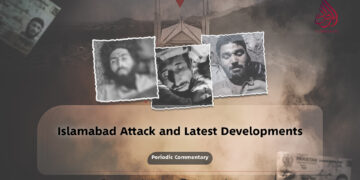
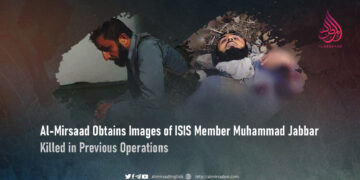
Two days ago, Al-Mirsaad published a report stating that a man named Muhammad Iqbal was killed by unidentified individuals in the Orakzai region of Khyber Pakhtunkhwa. Muhammad Iqbal was an important member of Pakistani intelligence and maintained continuous contact and coordination with ISIS operatives.
In other words, at one and the same time, he was both a member of the ISI and of ISIS. On one side, he would facilitate ISIS members, provide them with training, assign them targets, and deploy them for operations. On the other side, all of these activities were carried out under the guidance and direction of the ISI.
You can describe him as a bridge between the intelligence agencies and ISKP operatives. But not only that he himself was also a kind of leader who would prepare plans for the ISI, then pass those same plans on to these groups, and through these schemes attempt to achieve their objectives.
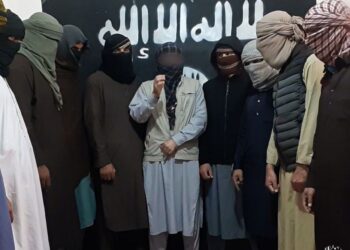
Recently, a renowned religious scholar from Khyber Pakhtunkhwa, a teacher of thousands of students, an ornament of numerous madrasas, and a distinguished Sheikh al-Hadith at the national level, Maulana Muhammad Idris, was martyred in broad daylight in a marketplace. Immediately after his martyrdom, ISIS-Khawarij also claimed responsibility for the killing.
At the same time, the Pakistani state attempted, through unofficial individuals, to use this painful incident for its own objectives and political interests. However, the killing of Muhammad Iqbal and his connections with both sides brought forth a very shocking and significant revelation.
The ISIS elements that spread corruption within the country and even across the world leave no Muslim safe from their harm. They have reached the highest levels of brutality and savagery, introducing new forms of oppression and violence, and they descend upon the righteous servants of Allah like a calamity.
The destruction and devastation of mosques and religious Madrasas has become their profession, and people associated with religion are their primary targets. They show a particular hostility toward humanity itself; burning people alive, attaching explosives to them and blowing them up, and reducing their bodies to ashes have become their methods.
The killing, kidnapping, and misguidance of innocent children has turned into a systematic mission for them. The humiliation of women, ruthless killings, and terrifying behavior have become widely known among both the general public and elites.
Overall, this group an embodiment of terror, brutality, and oppression, through the exposed information about Muhammad Iqbal, shows that it has the support of the state of Pakistan and its intelligence agencies, and that ISIS-Khawarij carry out their dark activities directly under their guidance.
This is not the first time such a situation has emerged, leading to claims of connections between ISIS-Khawarij and the ISI. Rather, such incidents have occurred multiple times before, again and again.
Across various regions from Karachi to Khyber Pakhtunkhwa and Balochistan, in the past year alone, there have been multiple incidents in which unidentified individuals have targeted ISIS operatives in such a way that their full information and data were exposed to the public.
Their connections were revealed, and instructions linked to Pakistan’s intelligence agencies and state officials were repeatedly brought to light.
It has even happened several times that state institutions detained ISIS-linked groups caught in clear acts of murder or other crimes, but later senior officials intervened, ordered their release, and stated that “these are our own people,” warning others not to take action against them.
This issue has become so widespread that even Pakistan’s political leadership, including senior politicians, have begun openly mentioning it in speeches and public gatherings.
But the question is: why do state institutions follow this dual approach? On one hand, they raise alarm over insecurity, accuse neighboring countries, and use every possible narrative to influence public opinion. Their constant slogans of “this is a terrorist and that is a terrorist” never stop. On the other hand, behind the scenes, the same institutions are accused of nurturing one of the world’s most brutal and notorious groups, providing them shelter and operational space.
Residents of Tirah have openly stated that their houses are being vacated and then handed over to ISIS. This raises the question: what is the objective behind all of this? Are Pakistan’s intelligence agencies trying to spread instability within their own country in this way in order to strengthen fear and consolidate control?
Is the aim to remove from the scene those who understand the reality of the situation and might speak the truth and inform the people about what is really happening? Are state institutions using these methods to further strengthen the privileges and benefits that are built on the hardship and labor of the people?
Is it possible that intelligence agencies first create instability through such groups, and then divert international attention towards themselves in order to present themselves as victims and shift the blame onto others? And do these agencies aim, through such unclean groups, to disturb the security of other countries, damage their credibility, and then later go there in exchange for rewards and control their trained elements? These are all questions that arise in light of these incidents and deserve serious consideration.
In the end, on one hand the Pakistani military regime loudly claims that the monster of terrorism is sitting on its head, and for this it blames Iran, Afghanistan, and India, considering them partners in this crime. It even goes as far as killing its own people, Baloch, Pashtuns, Sindhis, and Punjabis, and filling prisons with them.
But when the facts come to light, it appears that the same terrorists who have shocked Pakistan and the entire world are also operating under the shadow and support of these very institutions. So one is left wondering: this terrorism that everyone is shouting against, where does it actually originate from? This is a question, and the entire public is its audience.