




















By Ajmal Ghaznavi
The long pages of history reveal a lasting truth: no empire, no power, and no strategy has ever been able to break the determination of a living nation. Powers come, draw their plans, start wars, and then disappear into the darkness of history after defeat. But nations remain, because a nation is the power of land, faith, honor, and identity, a force that does not break even in the face of coercion, conspiracies, and intelligence games.
In modern history, this reality has been repeated once again. When the international coalition led by the United States began the war in Afghanistan in 2001, many strategic centers around the world believed that the balance of power would change for a long time. Advanced weapons, large armies, and global pressure were all mobilized to defeat the Afghan nation. However, the outcome of the war showed that when a nation stands for its identity and independence, even the greatest powers in the world cannot break its will.
After the end of this experience, global politics entered another phase. Military presence decreased, but political and intelligence rivalries became even deeper. The powers that did not succeed on the battlefield are now trying to find new avenues of influence, methods that create instability among regions and allow them to implement their strategies through regional circles.
In this equation, the geography of South Asia has once again become a center of political competition. In particular, some circles within Pakistan’s military structure face accusations that, at a sensitive stage of global rivalry, they are being used to implement foreign objectives. According to these allegations, efforts are being made to keep the region under continuous pressure so that the balance of strategic calculations can be altered.
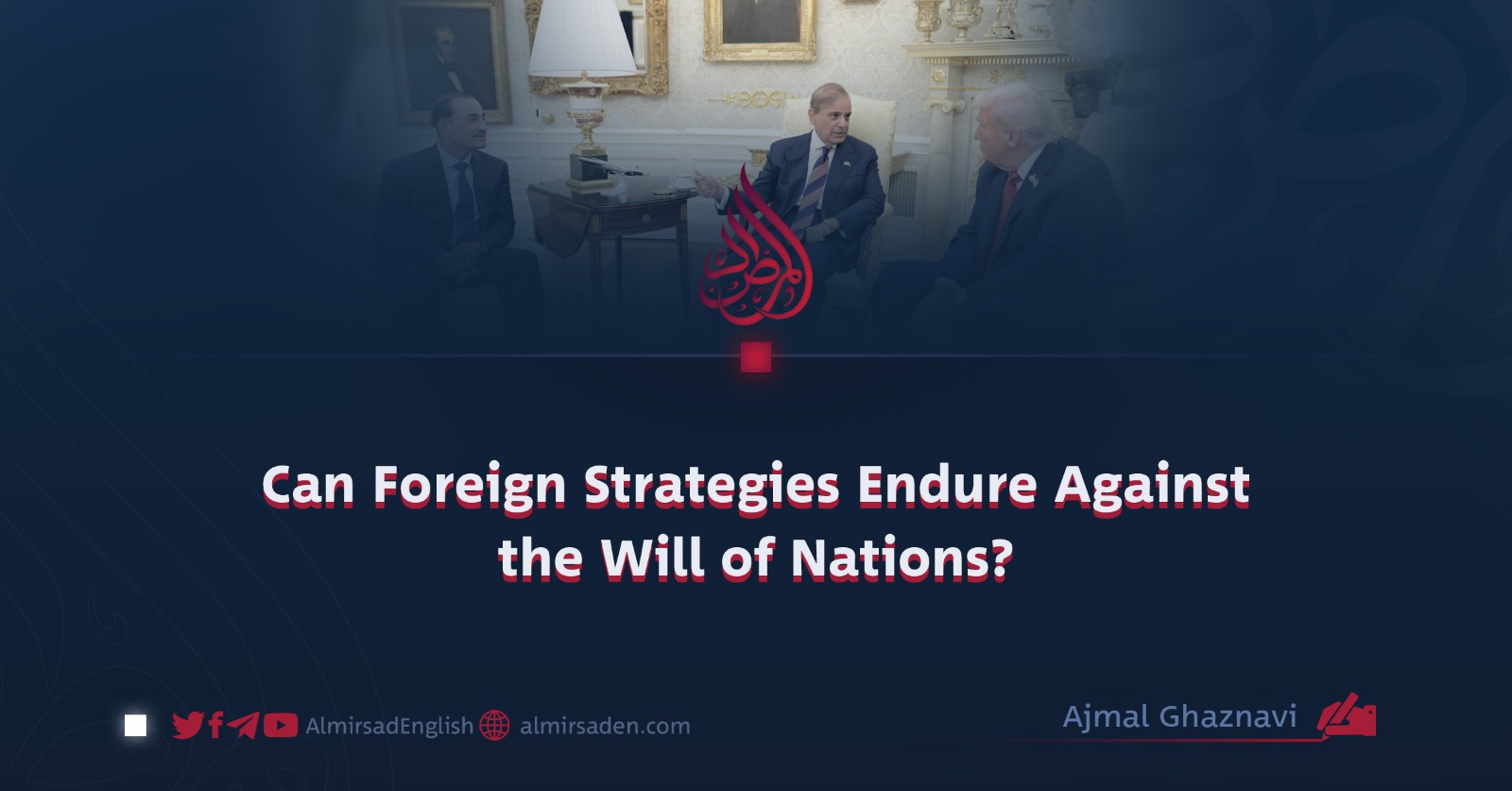
A series of political meetings and visits has also become part of this discussion. Pakistan’s army chief, Asim Munir, has strengthened contacts with political circles in Washington several times, and Pakistan’s Prime Minister Shehbaz Sharif has also emphasized relations with the United States. The U.S. President Donald Trump has likewise made statements regarding the region’s security dynamics, which have become a subject of discussion among analysts.
At the same time, the broader geography of the region stands under the shadow of potential new confrontations. The increasing pressure on Iran, the crises in the Middle East, and the rivalries among global powers have turned the region into the center of a major strategic contest. Yet, within all these equations, the most important element remains the will of nations.
History also shows us that strategies often appear powerful on paper, but when they confront the will of nations, they fail. The reason is that a strategy is the plan of a few politicians, while will is the collective consciousness of an entire nation. Plans are designed on the desks of offices, but determination is strengthened through sacrifice, struggle, and faith.
Nations do not collapse when war is imposed upon them; they collapse when they lose their will. But as long as the will remains alive, even the most complex political games in the world cannot alter the future of that nation.
This is why, today, a fundamental question arises in the region’s political landscape: can the strategies designed for the interests of foreign powers endure in the face of the will of nations over the long term?
History so far provides a clear answer: empires have fallen, strategies have changed, powers have shifted, yet the nations that have considered the defense of their dignity and independence as their mission have endured.
In the end, the final decision does not rest with weapons, intelligence, or strategies; the ultimate decision lies with the unbreakable will of the nations.