
By Abbas Ghaznavi
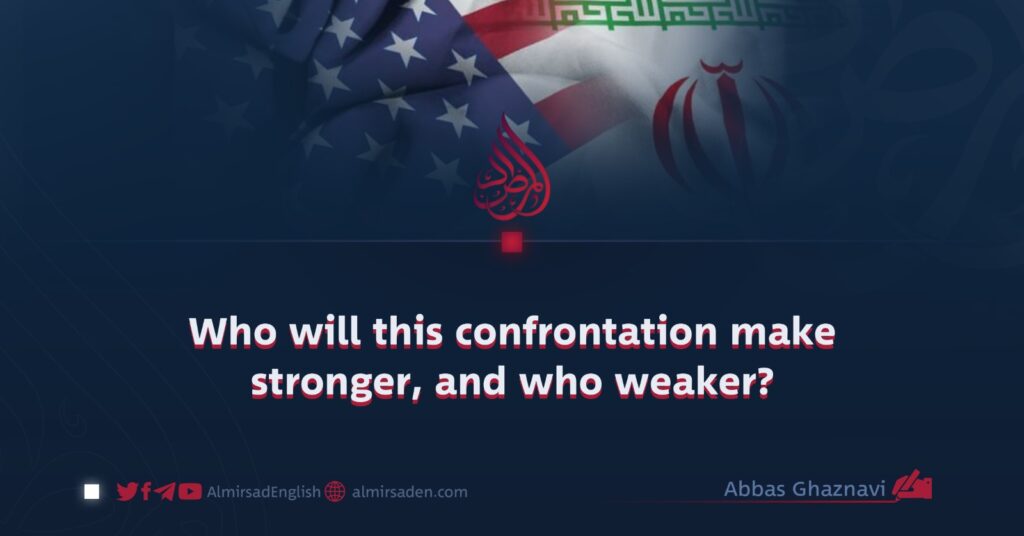
In a world where every moment has become a stage for hidden competition between power, politics, and economics, the ongoing confrontation between Iran and the United States is not merely a dispute between two countries. Rather, it resembles a sensitive moment in the redefinition of global balance. Here, every move is not just a tactic, but a new line on the map of power for the coming decades.
The United States, which still considers itself the center of the global order, is attempting to maintain its influence and avoid losing control over strategic routes. A vital chokepoint like the Strait of Hormuz is not merely a geographical location; it is a lifeline for the global economy. However, this time Washington is facing a world that no longer changes with a single gesture. Here, every action is assessed under the shadow of global powers, economic pressures, and political constraints.
From the other side, Iran represents a position in which retreat is seen as equivalent to defeat. Its policy is not only about survival, but also about expanding influence. Iran seeks to establish itself as a power that not only preserves its independence but also plays a central role in shaping the regional balance. For this reason, its response to every pressure is not merely defensive, but a form of active resistance.
However, the question remains: in this long and complex competition, who will emerge stronger and who will become weaker?
The answer is not simple, because this confrontation cannot be measured in the military domain alone. If the conflict expands, neither side will remain safe from the shadow of losses. The global economy will be shaken, energy prices will rise, and regional stability will face severe threats. In such a situation, the real advantage will go to those who have the ability to manage crises, not to those who merely seek confrontation.
The United States may have military superiority, but the costs of a prolonged war, internal pressures, and international political constraints can turn this advantage into a heavy burden. In contrast, Iran, although facing economic pressures, has developed capabilities through asymmetric warfare, regional ties, and experience in long-term resistance that enable it to withstand such pressures.
In the meantime, the real change is taking place within the international system. The era in which a single power could control everything without competition is over. A multipolar world has turned every confrontation into a far more complex equation. Here, the weakening of one country does not guarantee the absolute rise of another; rather, it opens the door for new actors to emerge.
So the conclusion is that this confrontation will not only produce winners and losers, but will also reshape the very definition of power. The strong will be those who can manage peace alongside war, while the weak will be those who rely solely on force and ignore the realities of a changing world.
In the end, this competition reveals a major truth: in today’s world, real power does not lie only in weapons, but in wisdom, patience, and strategic vision. Those who understand this will be the ones standing at the center of tomorrow’s global map.