
By Abid Mujahid
The two Eids are a gift and a mercy from Allah Almighty to the believers. In both, alongside the joy of this world, Muslims receive spiritual rewards and blessings that extend far beyond it. But Eid al-Adha carries a philosophy of particular depth, one that stretches across Islamic history and indeed across all of human history. Every year, millions of Muslims from every corner of the earth gather at the two holy sanctuaries and reenact the rites of Prophet Ibrahim (AS), Ismail (AS), and the mother Hajar (RA), in return for which Allah Almighty grants them reward and acceptance.
Beyond the spiritual dimension, Hajj and Eid al-Adha serve as a powerful means of unity, brotherhood, and mutual recognition among Muslims, cutting across every racial, tribal, and regional division. And they carry a message to all of humanity: that one day, in just this way, all of creation will be gathered before Allah Almighty to account for what they did.
At the heart of Eid al-Adha is the act of sacrifice. The word qurbani is derived from qurb, meaning nearness, drawing close. Its deeper meaning is rooted in one of the most extraordinary moments in human history. Ibrahim (AS) saw in a dream that he was slaughtering his son Ismail. For a prophet, such a dream is revelation. He shared it with his son, and Ismail, himself a prophet, surrendered to the command of Allah without hesitation or complaint.
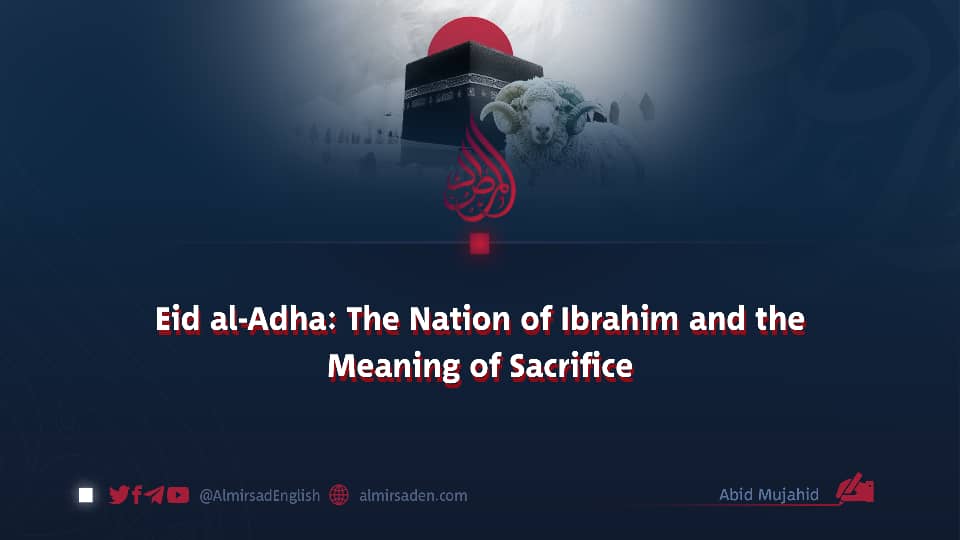
On the day that corresponds to Eid al-Adha, Ibrahim (AS) brought his son to the place of sacrifice and laid the blade against his throat. He said Bismillah, Allahu Akbar, and drew the knife. When he opened his eyes, Ismail (AS) stood beside him, unharmed. In his place, Allah Almighty had provided a ram to be sacrificed by Ibrahim’s hand. Ibrahim (AS) had passed the test.
As Allah Almighty says in the Holy Quran:
وَإِذِ ٱبْتَلَىٰٓ إِبْرَٰهِۦمَ رَبُّهُۥ بِكَلِمَٰتٍۢ فَأَتَمَّهُنَّ ۖ قَالَ إِنِّى جَاعِلُكَ لِلنَّاسِ إِمَامًۭا ۖ قَالَ وَمِن ذُرِّيَّتِى ۖ قَالَ لَا يَنَالُ عَهْدِى ٱلظَّٰلِمِينَ[سُوۡرَةُ البَقَرَة : 124]
And [mention, O Muhammad], when Abraham was tried by his Lord with commands and he fulfilled them. [Allah] said, “Indeed, I will make you a leader for the people.” [Abraham] said, “And of my descendants?” [Allah] said, “My covenant does not include the wrongdoers.”
(Al-Baqarah: 124)
From this true and sacred story, and from the final words of that blessed verse, a clear conclusion follows. Muslims today are not only called to sacrifice animals on Eid al-Adha. They are called to offer their wealth, their lives, and their children in the path of Allah Almighty. To turn away from that obligation is to count oneself among the wrongdoers.
Just as Ibrahim (AS) stood against Nimrod and his armies, and passed every severe trial Allah Almighty placed before him, Muslims today must come forward with complete sincerity in their obedience to Allah’s commands. Alongside the sacrifice of wealth, they must be willing to sacrifice their lives for the defense of Islam and for the protection of Muslim brothers, sisters, and children across the world, and for the preservation of the sacred symbols of this religion, so that Muslims and all people in Palestine, Burma, Pakistan, Iran, and every other land may be freed from the oppression of tyrants, and the ground may be prepared for the commands and laws of Allah Almighty to take hold.
This closeness to Allah Almighty will only be achieved when Muslims, in the truest sense, throw themselves into the fire as Ibrahim (AS) did, meaning they come forward in defense of Islam. As Ibrahim (AS) offered his own son for the sake of Allah Almighty, Muslims must be willing to offer what is most precious to them in defense of this faith, and to rise against the oppression of this age on the foundation of Allah’s commands.