
By Akbar Jamal
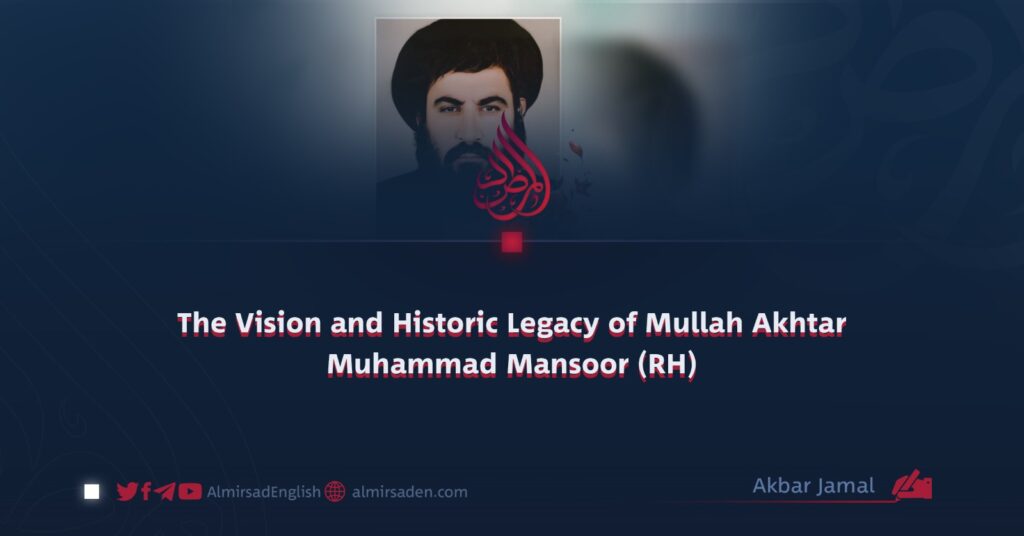
Of all his achievements, the one that stands above the rest is this: as Amir al-Mu’minin, Mullah Akhtar Muhammad Mansoor (RH) pulled the Islamic Emirate of Afghanistan (IEA) back from the edge of collapse at a moment when its very survival was in question.
The timing could not have been more dangerous. News of the passing of the IEA’s founder, Amir al-Mu’minin Mullah Muhammad Omar Mujahid (RH), had been suppressed for two years before it finally became public. When it did, the shock sent tremors through the movement’s organizational and psychological foundations.
But Mullah Akhtar Muhammad Mansoor (RH) met that moment with a clarity of faith, political instinct, and iron resolve that brought the situation under control and breathed new life into the movement. The enemy saw an opening and tried to exploit the internal divisions. Mullah Akhtar Muhammad Mansoor (RH) refused to answer with force or coercion. Instead, he chose the path of dialogue and reconciliation, drawing on the bonds of Islamic brotherhood and Afghan tribal tradition. He brought people back together not by overpowering them but by reasoning with them.
And even as he was stabilizing things from within, a threat was growing from without. ISIS, rising out of Iraq and Syria, was pushing into Afghanistan. It began pulling in disaffected members from within the IEA and attempting to build a parallel network under the name “Wilayat Khorasan,” with the clear aim of splitting the Afghan jihad into competing factions.
Mullah Akhtar Muhammad Mansoor’s response was measured but unambiguous. He drew a firm religious and strategic line: two parallel groups operating under the banner of jihad and governance on Afghan soil would never be accepted. He organized the mujahideen and launched decisive military operations against ISIS Khawarij in eastern Afghanistan, particularly in Nangarhar and Zabul. By the time those operations concluded, ISIS had been pushed into a corner, stripped of influence, and the IEA remained the only dominant military and religious force on the ground.
Then came Kunduz. In September 2015, under Mullah Akhtar Muhammad Mansoor’s direct leadership and strategic direction, the mujahideen did something that stunned both the Kabul puppet administration and its American backers: they captured Kunduz, one of the most important provincial capitals in the north. It was the first major city taken by the mujahideen since the American invasion of 2001. The IEA withdrew after a few days, weighing military realities and the safety of civilians, but the message had already been sent. The capture lifted the morale of mujahideen and ordinary people alike, and it silenced any remaining doubts within the movement about Mullah Akhtar Muhammad Mansoor’s military judgment.
His vision extended well beyond the battlefield. He understood that the IEA needed to present itself to the world as a legitimate political alternative, not just a military force. He reorganized and reinvigorated the political office in Doha, and he laid the groundwork for formal and direct relations with key regional powers, including Russia, China, and Iran. The result of that diplomacy was significant: these global players came to see the IEA not as a destabilizing force but as a responsible actor capable of bringing stability to the region.
That political and diplomatic foundation, built quietly during his leadership, bore its fruit in 2021, when America’s defeat and withdrawal gave way to the IEA’s historic victory.
It was Mullah Akhtar Muhammad Mansoor’s faith-driven foresight and uncommon courage during that critical period that saved the Afghan jihad from internal fragmentation and kept it from being torn apart by the ISIS fitna. His clearest legacy is this: he held the movement together like a wall of steel. And that unity became the foundation upon which the dream of a complete Islamic system in Afghanistan was finally realized.