
By Khalil Tasal
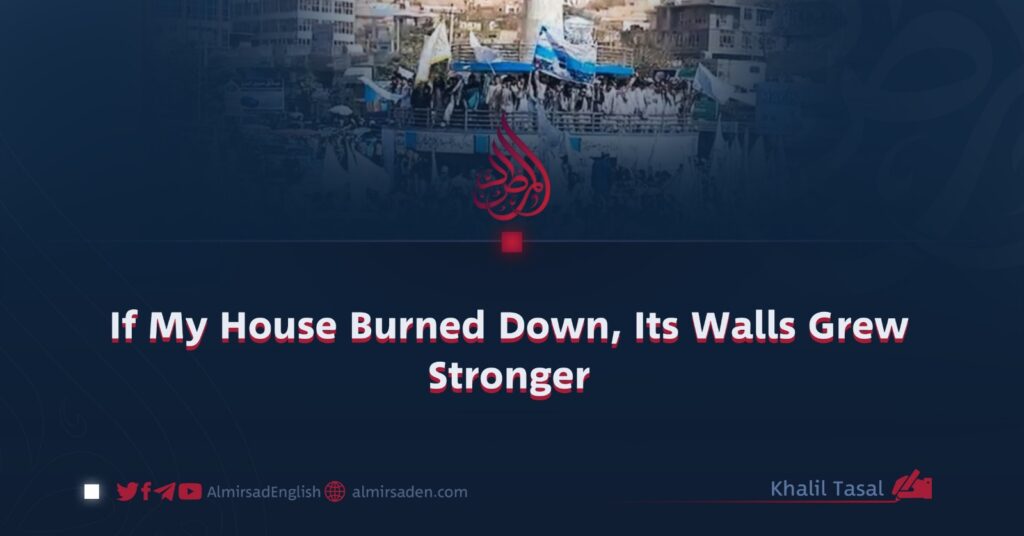
Yesterday in Baghlan province, hundreds of civilians, tribal elders, and young people gathered to condemn the Pakistani military regime’s attacks on Afghan territory while simultaneously voicing strong support for Afghan border forces and retaliatory operations. This event in Baghlan serves as an example of popular unity and national backing. Throughout the blessed month of Ramadan, similar support is expressed in mosques and community platforms, where prayers are raised for the stance of the Islamic Emirate of Afghanistan (IEA) and the efforts of its mujahideen. This is a historically significant and noteworthy occurrence, as it demonstrates to the Pakistani military regime the strength of a courageous people’s support and practical jihad, making it clear that a hired and mercenary army faces a determined Islamic force backed by genuine ideological commitment and popular backing.
The Islamic Emirate’s retaliatory operations, or “Rad al-Zulm” jihad missions, against the Pakistani military regime continue to achieve success, including numerous significant accomplishments such as the capture of dozens of Pakistani outposts and the elimination of over a hundred mercenary soldiers. History has shown that wars are won not through sheer force, but through morale and a noble purpose. With this principle in mind, defending the homeland is a form of sacred jihad. During the blessed month of Ramadan, the Pakistani military regime carried out attacks on Afghan territory, but in response, the IEA delivered decisive strikes through its ground and air forces, exacting a proud and effective retaliation.
Pakistan may have believed that it could achieve its long-standing objectives in Afghanistan through its mercenary forces, objectives that historically have been pursued via unnecessary interventions and various pretexts. However, the political and geographical realities have changed. Afghanistan now possesses a strong governing system, and there is widespread national consensus and unified public opinion against the Pakistani military regime.
On the other hand, the Pakistani regime has no legitimate reason for engaging in this cruel and oppressive war. Rather, it initiated the conflict to hide its weaknesses and domestic problems and to create the illusion of strength in the eyes of its own people. By now, it must be regretting its actions, as starting a war is easy, but winning it is difficult. Afghans, throughout history, have extensive experience in achieving victory in conflicts, whereas Pakistan has a long and shameful record of defeat, a history that needs no further elaboration here.
Now let us turn to the other side of this conflict: popular support and national consensus. In Pakistan, the general population has long been marginalized, with power concentrated in the hands of a small elite. Numerous political parties, religious leaders, and scholars have repeatedly criticized the military’s malicious policies and its manipulations in Afghanistan for the benefit of external interests. They have protested and condemned these actions as unjust. Yet the Pakistani military regime has not only ignored their voices but has also, from time to time, targeted and eliminated the leaders of these protests and demands.
Turning to the other side of the conflict, in Afghanistan, the situation is completely different. The IEA has put into practice a long-standing historical demand of the people: that the Pakistani military regime should no longer be met with nonviolence and pleas, but with firm and effective response. Here, the famous Pashto saying holds true: “If my house burned down, at least its walls became stronger.” Following its recent attacks on Afghanistan, the Pakistani military regime has witnessed firsthand the depth of Afghan resentment toward it and the extent of the population’s capacity to respond and retaliate.
It is clear to everyone that Afghan citizens, both inside the country and abroad, unanimously support the IEA ’s retaliatory operations. Sisters, mothers, and elders offer prayers for them during the blessed month of Ramadan. Even many living abroad, including former officials and members of the previous regime, acknowledge the courage and legitimacy of the IEA. In their analyses and opinions, they openly state that, for the first time in Afghanistan’s history, Pakistan is witnessing the sharp impact of a decisive response.
During the “Rad al-Zulm” operations, the spirit of popular support and national unity continues to rise day by day. The valiant security forces are met with public affection and backing; every time they return, ordinary citizens greet them with bouquets of flowers. In contrast, no one mourns the deaths of Pakistani militias members. Their military leaders and policymakers neither study history nor seek understanding from the perspectives of global politicians and historians. Afghans are weary of war and never seek it; after four decades, under the leadership of the IEA, the time has come to heal the wounds of past conflicts. Yet this does not mean that if another aggressor attacks, Afghans will remain silent or lack the ability to defend themselves.
In this ongoing conflict, the IEA’s foreign policy also plays an effective role. Its political representatives abroad have clearly conveyed to host countries that Afghanistan does not seek war, but rather bears the heavy responsibility of protecting its people and maintaining a defensive posture. For this reason, the IEA has never closed the door to dialogue or direct negotiations. In contrast, it is Pakistan that has consistently walked away from the negotiating table, inventing excuses to conceal its falsehoods.
There is no doubt that biased foreign circles, certain discredited Afghan politicians, and regional intelligence outlets aim to sow seeds of division among Afghans through false information and propaganda, or to create a rift between the security forces and the people. Yet they must understand that the nation is vigilant and now fully aware of who the true servants and defenders of the country are.