
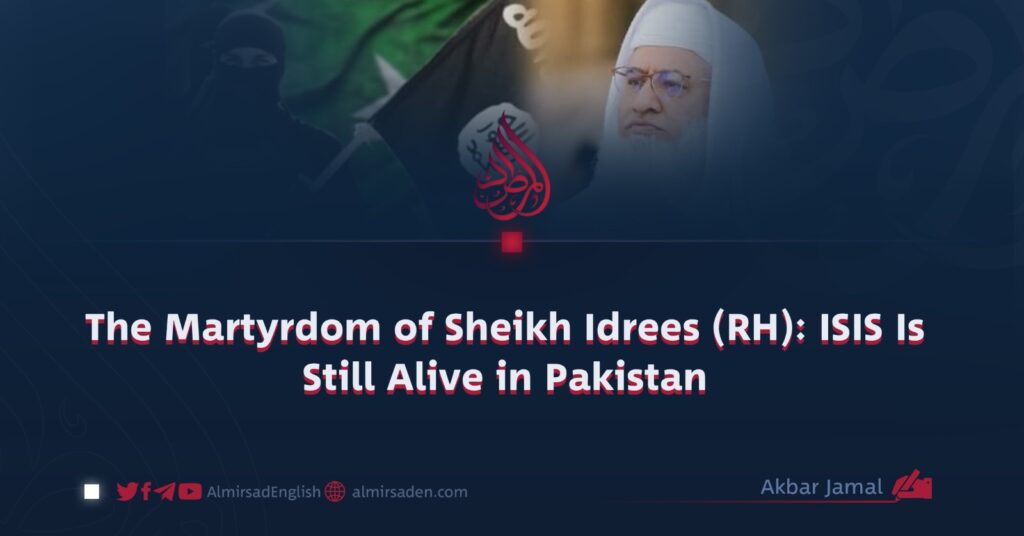
By Akbar Jamal
Sheikh al-Hadith Maulana Muhammad Idrees was one of the most respected and distinguished religious scholars in Pakistan. A hadith scholar of the highest rank, he had spent decades in teaching and education, trained thousands of students in Quranic sciences and hadith, and was widely regarded as a scholarly authority across his region.
He was also affiliated with Jamiat Ulema-e-Islam (F), where he held a prominent position at the provincial level and carried real political weight in Khyber Pakhtunkhwa. But he was never just a teacher. He was a community figure, someone who actively worked to resolve local disputes and maintain peace and order on the ground. He had taken a clear and public stand against extremism and armed militancy in Pakistan, which is precisely why he had long been a target of radical groups.
Yesterday, ISIS murdered him in cold blood. His martyrdom is a profound loss, both scholarly and political.
His killing has reignited fears that have been quietly growing for years: that senior religious scholars in Khyber Pakhtunkhwa are being eliminated according to a deliberate plan, one designed to create a vacuum of religious authority and clear the path for extremism to fill the space left behind. The immediate claim of responsibility by the Pakistani branch of ISIS-K reopened wounds that the people of this region have been carrying for a long time.
This was not simply the killing of one scholar. It was also a direct blow to the Pakistani military’s official narrative, the one they have spent years selling to the public: that terrorism has been rooted out of the country. The reality is that Pakistani blood is still being spilled with the same brutality it has always been. The same army that turned its guns on the Muslims of Bangladesh in 1971 continues, in its own way, to preside over the deaths of its own people.
What is most disturbing are the questions now being raised openly, no longer in hushed tones, about the military’s intentions and its long-suspected double game. Across political and public circles in Pakistan, people are asking out loud: why is it that the senior scholars of Khyber Pakhtunkhwa, the very people who serve as a bulwark against extremism, keep being targeted, while the state’s security apparatus stands by looking helpless? This is a province the military claims to control completely. So what exactly is that control being used for?
The martyrdom of scholars like Sheikh Idrees makes one thing undeniable: ISIS is not some distant threat to Pakistan. It is an active, present reality inside the country. And every time ISIS is mentioned, fingers turn toward the military circles that were supposed to be responsible for protecting people like him. The most serious and troubling accusations are those alleging that the Pakistani military has been actively enabling ISIS, creating the conditions for it to operate. What has been happening in the Tirah Valley has only strengthened those suspicions.
The contradiction is stark. The same valley from which civilians were driven out in the dead of winter, supposedly to allow military operations against terrorists, is now the source of reports about ISIS establishing bases. The public perception in Pakistan has hardened into something beyond suspicion: that the so-called war on terror was never about ending terrorism. It was about relocating it, repositioning it, using it as a strategic instrument. If the military’s operations were genuinely aimed at peace, why are people like Sheikh Idrees still being killed in their own homes? And if operations in Tirah were truly targeting militants, why are we hearing about their settlement there rather than their defeat?
This double game has brought Pakistan to a place where the bond of trust between the state and its people has been almost completely severed. On one side, grand declarations about operations like “Azm-e-Istehkam.” On the other, ISIS expanding without serious obstruction, making every one of those declarations ring hollow. Political analysts in Pakistan are now saying plainly what many have believed for years: as long as the state and military continue using ISIS as a tool for political and regional ends, peace in Pakistan and across the region will remain nothing more than a fantasy.
Today, the questions written in Sheikh Sahib Idrees’s blood demand answers. Is this regime genuinely a protector of its own people? Or is it simply an arena where human lives are moved around like pieces on a board?
If the military wants to clear itself of the accusations of complicity being leveled against it, it needs to bring transparency to its policies, from the Tirah Valley to Washington. Because if it doesn’t, the blood being spilled unjustly today will eventually pull up the very roots of the regime that claims to be fighting in its name.