
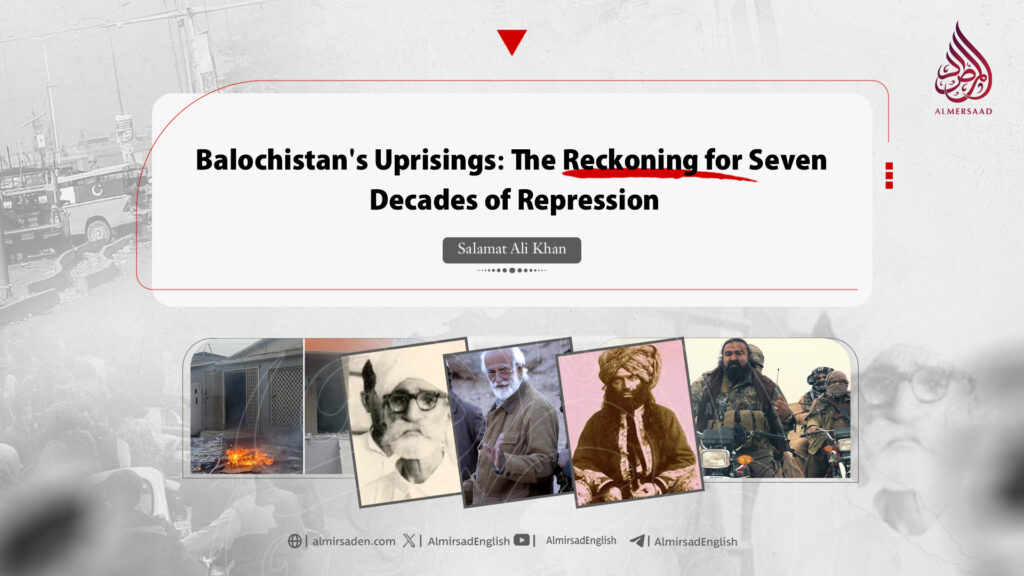
By Salamat Ali Khan
Early Saturday, an abrupt and dramatic situation unfolded in several cities across Balochistan, including the provincial capital, Quetta, as Baloch separatist forces surged into key districts. At daybreak, the fighters seized major roads, government buildings, and a number of strategically sensitive locations. State installations reportedly suffered heavy damage in multiple areas, while residents said that vast stretches of the province were, in practical terms, under separatist control and that the provincial center itself had now been openly occupied.
One of the group’s leaders, Bashir Zaib, appeared in a video message riding a motorcycle alongside other armed men and urged the entire Baloch nation to rise up and free itself from the military regime. Amid the turmoil, other individuals exploited the breakdown to attack public property, and early reports indicated that three or four banks were completely looted. Observers said this marked the first time in many years that Baloch separatists had entered a major city such as Quetta so openly, moving through public spaces at will and acting without restraint. Beyond government officials, members of the public were also seen posing for celebratory photographs with the fighters and circulating them enthusiastically online rather than condemning their presence.
In the past, separatist operations had largely consisted of sporadic attacks in remote districts far from provincial centers. This time, however, the campaign unfolded on a far wider scale, signaling what appeared to be the opening of a new and more confrontational phase. Pakistani officials responded in familiar fashion, branding the events terrorist attacks and insisting that innocent civilians had been endangered. Leading analysts and longtime observers of Balochistan, however, contended that the uprising should instead be read as the accumulated backlash to decades of repression under Pakistan’s coercive military regime.
Earlier this year, prominent Baloch political figure Sardar Akhtar Jan Mengal remarked that Baloch youth were no longer inclined to heed the warnings of older leaders and that established figures now had little choice but to stand alongside them. In an interview with Voice of America (VOA), Qamar Cheema, the Islamabad-based executive director of the Sanober Institute, described the growing sympathy among senior leaders for the separatists, along with the visible participation of young people and women, as a striking shift. In his assessment, the forces driving this turn were Pakistan’s heavy-handed policies and the steady stripping away of Baloch rights.
Historians of the Baloch separatist movement note that tensions between the Baloch population and the Pakistani regime date back to the country’s birth. At the moment of Pakistan’s creation, the ruler of the former princely state of Kalat, the Khan of Kalat, resisted annexation into Pakistan and warned that armed resistance would follow if force were employed. At that time, all Baloch inhabited territories from Quetta to Gwadar lay under his authority, and governance was conducted according to Islamic law.
The region was also known for its judicial institutions, overseen by Sheikh Shams-ul-Haq Afghani, a leading scholar of the era and a graduate of Darul Uloom Deoband, Asia’s largest Islamic seminary. Pakistani authorities brushed aside these arrangements and turned to military coercion, launching aerial bombardment and other campaigns of force. Through these measures they asserted control over Baloch areas and partially crushed the armed uprising declared by the Khan of Kalat.
When a military coup elevated Ayub Khan to power, relatives of the Khan of Kalat launched another rebellion. The uprising was led by Nawab Nauroz Khan. After years of sustained resistance, Ayub Khan offered amnesty if Nauroz Khan would surrender and lay down his weapons. Prominent figures were presented as guarantors of the pledge, and Nauroz Khan descended from the mountains and gave himself up. Pakistani authorities soon reversed course. He and his son were hurried to the gallows and executed, a killing supporters describe as a savage betrayal of solemn promises.
Although this episode appeared to close one chapter of uprising, the conflict flared again during the rule of Zulfikar Ali Bhutto. Balochistan rose in opposition after Bhutto dissolved a provincial government led by Baloch politicians and jailed senior figures, including Sardar Ataullah Mengal. He also ordered punishing bombardments of the Marri and Jhalawan regions, employing force and intimidation to compel submission. These operations were exceptionally brutal, killing large numbers of men, women, and innocent children.
Those campaigns seeded a new and lasting bitterness toward the Pakistani state. Nearly half a century later, those years still loom over the province. Destroyed villages and stories of indiscriminate violence remain part of collective memory. Out of that anger emerged yet another armed phase, led by Babu Sher Muhammad Marri and Mir Hazar Khan. Known simply as “Sher,” Marri orchestrated retaliatory operations that cut off large areas from government access and inflicted heavy losses.
The balance shifted after the Soviet invasion of Afghanistan, the fall of Bhutto’s government, and General Zia-ul-Haq’s seizure of power. Fearing that Soviet forces might arm the Baloch for its own ends, Zia reached out to regional leaders and implemented a “forgive and forget” formula, backed by promises meant to calm the province. The Baloch stood down and turned toward political engagement. That uneasy pause collapsed after Pakistan’s military general Pervez Musharraf ordered the killing of Akbar Bugti, a towering Baloch figure. Musharraf later addressed the nation and portrayed Bugti’s death as a triumph, using harsh and demeaning language toward the entire Baloch people. It reopened old wounds and convinced many that dialogue offered little protection. Militancy surged again, spreading across the province and now, for the first time in years, reaching the heart of Quetta itself.
What Lies Behind the Conflict Between the Baloch and Pakistan’s Rulers?
A detailed article by an American institution known as the New Lines Institute examined the question at length, tracing the roots of the conflict alongside the historical evolution of the Baloch separatist movement. According to the report, the central grievance voiced by the Baloch people concerns their rights. Pakistan’s gold, gas, electricity, and nearly all of the mineral resources on which the country depends are extracted from Balochistan. Yet Pakistan’s rulers, the article argues, have failed to deliver meaningful benefits to the communities whose land produces that wealth.
Revenue flowing out of Balochistan has turned other regions into islands of prosperity, while the people living atop those resources remain mired in poverty. Vast tracts of land lie barren. Houses stand broken. Rooms are dark and undersupplied. Even cities that feed natural gas into the national grid endure bitter winters, forcing residents to collect firewood just to heat their homes. Under such conditions, many Baloch feel driven to pursue whatever means remain to claim their rightful share.
International observers maintain that the dispute runs deeper than economics. Since Pakistan’s founding, successive governments have pursued policies meant to crush the Baloch socially and politically, denying children education, stoking tribal rivalries, weakening public health, and preventing the emergence of leaders capable of challenging abuse.
It is in this context that Pakistani authorities killed Akbar Bugti through coercion and brute force, a moment that stunned the country and continues to draw condemnation from politicians, religious scholars, and citizens across Pakistan’s ideological spectrum.
Over the past two decades, Pakistani authorities have been accused of dragging thousands of Baloch from their homes, leaving families trapped in agonizing uncertainty over whether loved ones are alive or dead. Activists, including Mama Qadeer, marched and protested for months and in some cases years in search of answers, only to face harassment and abuse.
Accounts describe repression spreading to other regions as well, with killings and mistreatment escalating. People were seized without warrants, never presented before courts, and made to vanish. Families say they seek nothing more than to know whether those taken still live.
Relatives even secured orders from Pakistan’s Supreme Court, yet officials brushed them aside. They accuse rulers who behave like absolute tyrants, Pharaohs in all but name, of flouting humanitarian norms, Islamic principles, and international law.
During the past four years, a young woman from the region, Mahrang Baloch, emerged as a prominent voice for families of the disappeared, legally requesting permission to organize demonstrations in Islamabad. Authorities denied the applications, detained many of her associates, and caused them to vanish. When large numbers of Baloch rallied behind her, the response was not dialogue but her own imprisonment in secret locations, where she is reported to remain.
Pakistan’s rulers have meanwhile continued to blame outside powers, alternately pointing to Afghanistan, Iran, or India and accusing each of undermining national security. Those claims have at times boiled into diplomatic crises and cross-border strikes, including clashes with Iran last year.
Critics counter that the core reality lies much closer to home. For more than seven decades, Pakistan’s governing elite has ruled Balochistan through coercion, crushed dissent, stripped communities of political and economic rights, and violated Islamic, humanitarian, and international standards in its treatment of civilians. Governments have tried again and again to silence Baloch voices by force.
History suggests that such pressure does not extinguish demands for justice.
It sharpens them.