
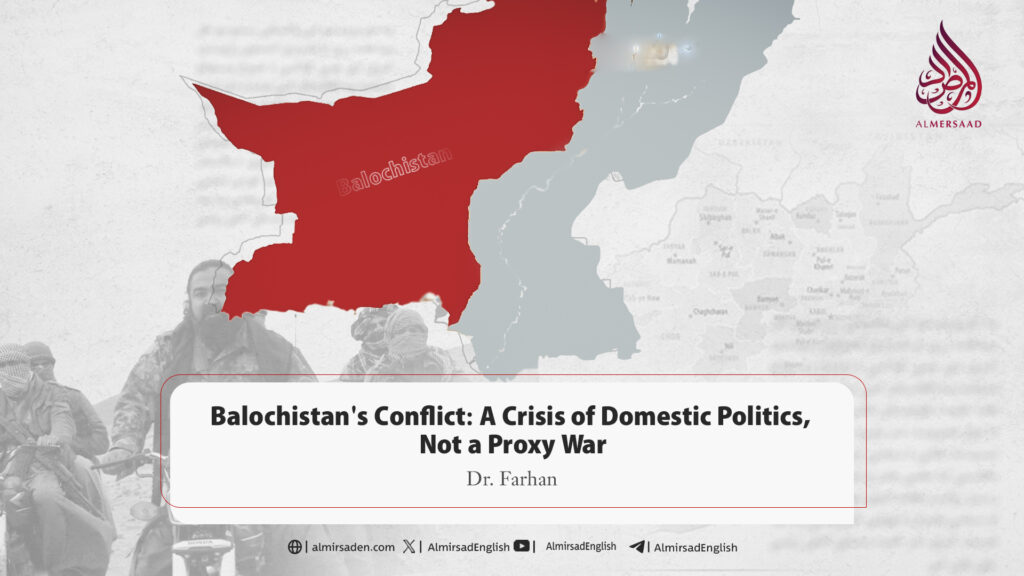
By Dr. Farhan
In recent days, Pakistan’s media has once again returned to a familiar and well-worn storyline: claims that the leadership of Baloch armed groups is based in Afghanistan and that the conflict in Balochistan is being directed from across the border. These assertions, however, appear driven far more by political convenience and propaganda calculations than by verifiable evidence. The prevailing narrative attempts to recast what is essentially a domestic political and security crisis as the result of foreign interference, thereby diverting attention from the conflict’s underlying causes.
A closer look at what is actually known points in another direction entirely. Available evidence and assessments offered by regional observers indicate that the principal Baloch leadership and decision-making centers remain firmly inside Balochistan itself. The coordination of hostilities, oversight of operations, and formulation of strategy are unfolding within the same social and political environment in which the conflict first took root.
History offers a simple and enduring lesson: popular resistance movements, whether highly organized or loosely networked, draw strength from their own terrain, social relationships, and local support systems. Ignoring that reality reflects either analytical weakness or a deliberate effort to blur the picture. Within Pakistan’s official discourse, repeated references to Afghanistan function largely as a political instrument. The Pakistani military regime has long sought to deflect responsibility for its security failures, deepening resentment in Balochistan, and the consequences of its hard-line policies by assigning blame to external actors. This approach serves two purposes at once. At home, it distorts public perception. Abroad, it presents the crisis as something beyond Pakistan’s control and driven by foreign hands. Such claims are often deployed to deceive the world, relieve political pressure, and attract foreign assistance rather than to confront realities that demand serious internal reckoning.
If Baloch leadership were genuinely directing the conflict from Afghan territory, it is difficult to imagine such activity escaping the attention of international intelligence agencies, security services, and monitoring bodies. Yet no credible global report, documentary record, or body of evidence has emerged to substantiate these allegations. Instead, a growing body of research points in another direction entirely. The conflict in Balochistan appears rooted in Pakistan’s own internal politics, the entrenched dominance of military institutions, and decades of suppressed political demands.
Invoking Afghanistan in this way does little to advance a meaningful solution. On the contrary, it functions as a calculated evasion of responsibility. Unless Pakistan seriously addresses the Baloch population’s legitimate grievances, political marginalization, economic disparities, and well-documented human rights concerns, rhetorical accusations will neither slow the violence nor change the trajectory of the crisis. Its persistence suggests that the problem lies in Quetta and Islamabad rather than in Kabul.
In the final analysis, the armed Baloch resistance is not the product of foreign orchestration but a reaction to years of internal pressure, systemic injustice, and oppression under Pakistan’s military regime. The leadership of the struggle remains where the wounds were inflicted, and until those wounds are openly acknowledged and addressed, directing blame outward will amount to little more than an attempt to avoid confronting hard truths.