
By Akbar Jamal
The forced displacement of residents in Pakistan’s Tirah Valley, located in Khyber Pakhtunkhwa Province and reportedly undertaken at the behest of Pakistan’s military regime, is not merely a security operation. It has instead become a revealing case study of how power is exercised in Pakistan, how political decisions are shaped by entrenched interests, and how dissenting voices are suppressed. Several weeks ago, Pakistan’s military regime announced a new campaign in Tirah Valley under the pretext of the presence of Tehrik-e Taliban Pakistan (TTP). Through a series of warnings delivered to local residents, the population was told it must vacate the area by the end of January.
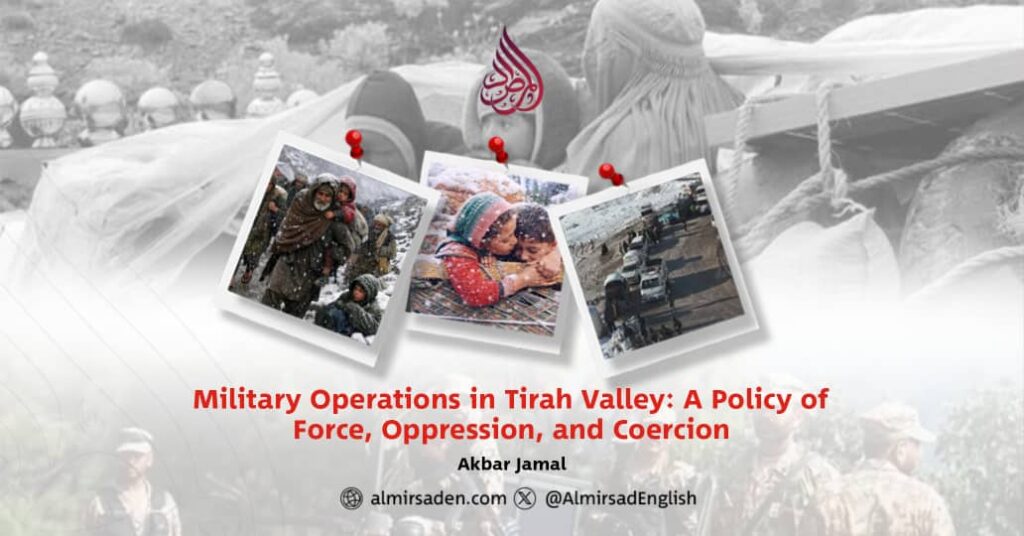
The consequences were immediate and devastating. Thousands of families were compelled to abandon their homes and belongings in the depths of winter. Snow blanketed the region, roads were blocked, vehicles were left stranded, and according to verified video reports, a number of innocent children lost their lives because of freezing temperatures, hunger, and the absence of basic necessities.
The scale of the crisis was such that international media outlets, including Al Jazeera, reported on the unfolding events.
Across the globe, pointed questions were directed at Pakistan’s military regime: can the collective punishment of an entire civilian population, carried out under the banner of counterterrorism, truly be considered the conduct of a professional army?
When international criticism mounted, Pakistan’s military authorities abruptly shifted their position, asserting that no formal evacuation order had ever been issued to the residents of the area.
That claim, however, is contradicted by the regime’s own earlier statements, recorded press briefings by the DG ISPR, media coverage, and official government documents, all of which clearly reference the announcement of operations. At the same time, politically informed circles across Pakistan and the Khyber Pakhtunkhwa provincial government, particularly Chief Minister Sohail Afridi, voiced strong opposition to the campaign.
The provincial administration’s position is not only humanitarian but also grounded in on-the-ground realities.
KP Chief Minister Afridi has argued that since 2007, Pakistan’s military regime has conducted dozens of similar operations, yet achieved neither durable peace nor the elimination of so-called terrorism. The newly announced operation in Tirah Valley, he warned, threatens to repeat the same policies and produce the same outcomes Pakistan has witnessed before. Once again, the displacement of hundreds of thousands of people in severe winter conditions raises the specter of a large-scale humanitarian catastrophe.
When the provincial government pressed the military regime on its shifting narrative and questioned its seriousness, accusing it of retreating from its earlier statements, powerful pro-military circles launched an offensive against the Khyber Pakhtunkhwa government. Military-aligned media outlets, federal institutions, and narrative-shaping actors began speaking in near unison, alleging that the provincial government was “defaming state institutions (armed forces).” In the midst of this political escalation, an Islamabad court unexpectedly issued a non-bailable arrest warrant against CM Sohail Afridi on cybercrime charges.
According to informed observers, this development was no coincidence. Instead, it is widely interpreted as part of a longer-standing policy through which Pakistan’s military regime seeks to remove any obstacles to its interests, economic ventures, and controversial commercial projects.
The costs of such a policy are not borne by Pakistan alone. They also undermine the credibility and institutional standing of the military itself.
Nevertheless, the military regime continues to justify its actions by insisting, “We are doing all of this for the benefit of the people.” Meanwhile, the residents of Tirah Valley remain trapped in snow and bitter cold, facing severe hardship in circumstances that some inside Pakistan have likened to a Gaza-like tragedy unfolding within the country’s own borders.
Such statements that military operations in certain regions extend beyond security concerns are not new. Critics have long contended that such campaigns are often tied to economic calculations and mineral interests. Tirah Valley, it is frequently noted, is believed to be rich in natural resources, and many argue that the removal of local populations serves to keep these assets out of public scrutiny while clearing the way for extraction projects.
Under these conditions, the provincial government, which directly represents the affected region, has naturally resisted the operation. As a result, many serious political observers in Pakistan interpret the attempt to arrest Sohail Afridi as a blunt warning: anyone who challenges military policies, economic interests, business, mining interests, or the official narrative will be silenced through courts, cases, and coercive pressure.
The debate over the military regime’s role in Pakistan is no longer confined to Tirah Valley or to a single chief minister. It has become a question reverberating far beyond the country’s borders: are Pakistan’s elected provincial governments so powerless that even raising their voices in the face of a looming humanitarian disaster comes at such a steep cost?
Children stranded along snow-covered roads in Tirah Valley, families driven from their homes, and now an attempt to arrest an elected chief minister. These are all chapters in the same unfolding story, one in which the voice of military power outweighs truth, and strategic or commercial interests are treated as more valuable than human life.