
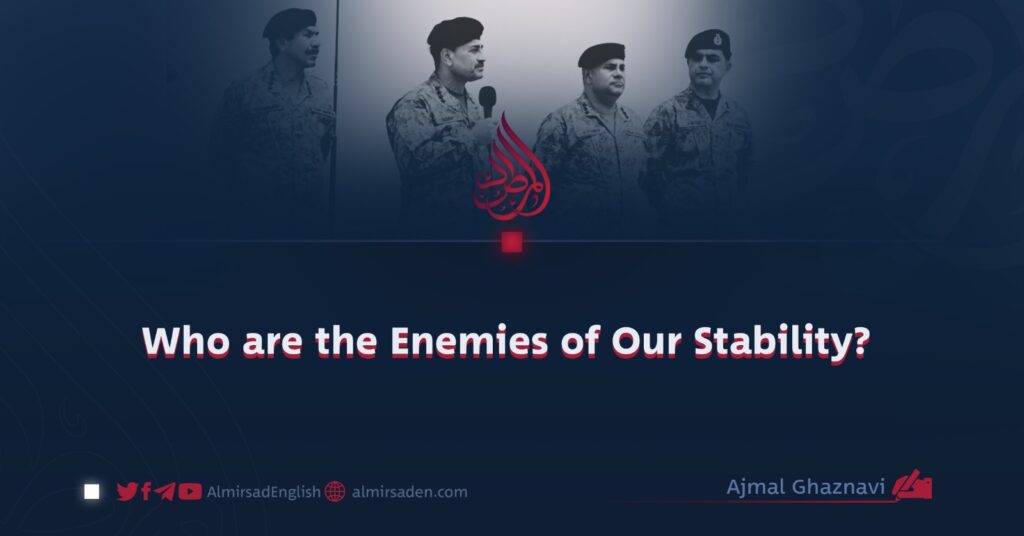
By Ajmal Ghaznavi
After long decades of wars, occupation, internal conflicts, and international interventions, Afghanistan is gradually moving toward a stage where signs of stability, security, and national focus are visible. Although this stability still faces economic hardships, international pressure, and political restrictions, it is nonetheless considered an important door of hope for the Afghan people.
This is precisely why every sign of peace in Afghanistan has become an alarm bell for those intelligence and political circles that have profited from the continuation of war for years.
Today, the biggest question is: who are the enemies of our stability?
Those who raise a storm of doubt, accusations, and propaganda against every instance of Afghanistan’s progress and political stability are, in fact, the enemies of this very stability. They know that a stable Afghanistan would mean the end of many artificial security equations in the region, because for years, the war in Afghanistan has served as a tool of influence for certain countries, a source of international aid, and a playground for intelligence games.
The Pakistani military regime is considered the most significant player in this game.
Whenever this country faces internal crisis, economic collapse, political disputes, and security failures, it brings the name of Afghanistan forward to conceal its problems. Sometimes it levels accusations under the title of the TTP, sometimes it blames Afghanistan for border insecurity, and at other times it presents a picture to the international community as if all the region’s security crises originate from Afghan soil; however, the truth is much deeper than this.
The Afghan nation, which has seen the flames of war in its own homes for forty years, understands the meaning of instability better than anyone else. A nation whose generations have fallen victim to migration, bombings, orphanhood, and economic collapse will never support another war. Today, Afghans are thirsty for peace, economic growth, and national stability. They do not want Afghanistan to be transformed into a field for regional proxy wars once again.
If armed groups are operating in the region, this issue must be examined in the light of intelligence policies, historical ties, and regional rivalries, rather than imposing everything on the Afghan people or Afghanistan. The same circles that yesterday funded various groups under the names of the “War on Terror” and “Security Strategy” are today creating new equations under the name of ISIS.
ISIS is not merely an accidental phenomenon; this group emerges and gains strength in areas where intelligence gaps, political objectives, and strategic games exist. Many regional analysts believe that ISIS is being used as a tool for pressure, fear, and instability to keep countries in a state of continuous security crisis. Reports mentioning training camps, safe passages, and secret support are considered part of this larger game.
The true enemies of Afghan stability are those who do not want Afghanistan to stand on its own feet. They fear that if Afghanistan becomes stable, the business of war will end, intelligence influences will weaken, and many of the region’s pressure cards will vanish. However, history has shown that the Afghan nation has maintained its identity even under the shadow of conspiracies. No matter how tired this nation has become, it has not been broken. Therefore, every project designed to shatter Afghanistan’s stability may cause temporary chaos, but it cannot break the will of a nation.
Today, the greatest need of the Afghan people is to focus on their national unity, internal stability, and political sagacity instead of propaganda, intelligence games, and foreign narratives. This is because stability is not only a requirement for the government but is a matter related to the future, honor, and survival of every Afghan. Afghanistan no longer needs to be a field for testing war; rather, it needs a land possessing internal stability.