
By Abdan Safi
In international politics, some decisions are not merely political; they reveal a state’s religious, intellectual, moral, and historical orientation. Pakistan’s decision to join Trump’s Gaza Board of Peace is one such case. It is not a routine diplomatic maneuver, but a choice through which Pakistan’s military has positioned itself against the Islamic Ummah, national consciousness, and historical responsibility, squarely within the ranks of American and Israeli strategic interests.
For decades, Pakistan’s foreign policy has steadily slipped beyond the control of civilian institutions and has effectively become subordinate to the military’s strategic calculations. On the question of Palestine as well, Pakistan’s official posture has rarely mirrored public sentiment; instead, it has been shaped in accordance with Washington’s preferences by the Pakistani military. Participation in Trump’s Gaza Board of Peace represents the latest link in this chain, once again demonstrating the military’s readiness to sacrifice the Islamic world’s most sensitive causes for its own survival and for the approval of foreign patrons.
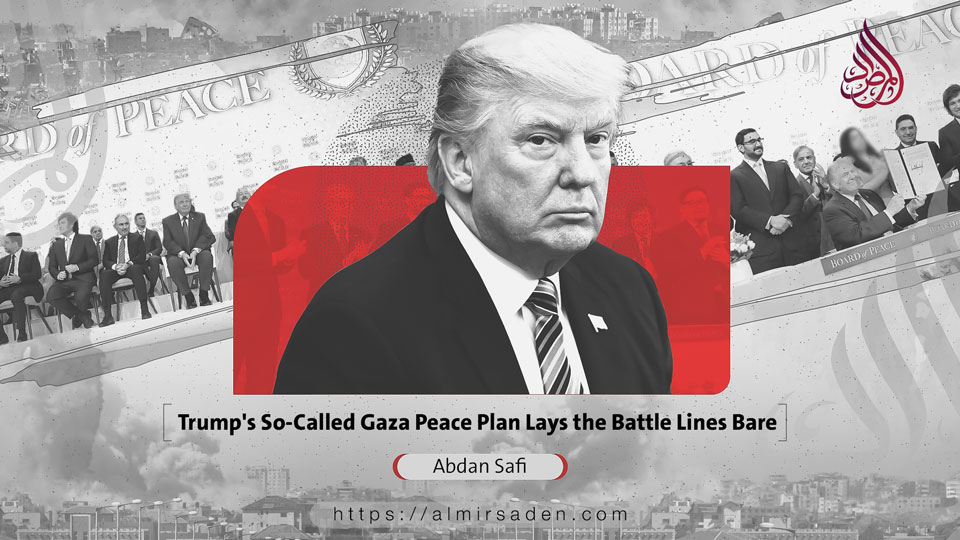
Under Trump’s leadership, this so-called “Board of Peace” was not conceived to establish peace, but to dismantle Palestinian resistance. Its central objectives are to disarm Hamas, fracture Palestinian political resolve, and legitimize Israeli security interests. Joining such a framework, in practical terms, amounts to endorsing Israeli occupation and adopting a position hostile to Palestinian resistance.
The most dangerous dimension of this development lies in the role of Pakistan’s military itself. An institution that brands itself an “Islamic nuclear power” and a “guardian of the Two Holy Mosques” has, in practice, become a proxy instrument for powers that are among the chief supporters of the mass killing of Muslims. This decision does not merely illustrate the military’s indifference to popular will; it also exposes how Islam is reduced to a slogan rather than upheld as a guiding principle for the unity or survival of the Ummah.
If the responsibility of a Muslim or Islamic state is to uphold Islam, support the oppressed, oppose occupation, and confront injustice, then joining Trump’s Gaza Peace Board stands in open contradiction to every one of those foundational imperatives. In this instance, Pakistan’s military is not defending Islam; it is eroding both Islam’s moral standing and the collective dignity of the Ummah. This single act has driven Pakistan down from even the final rung of credibility in the eyes of much of the Muslim world.
Through this move, the military has presented Pakistan to the world not as a sovereign state, but as a compliant subordinate. The decision amounts to rubbing salt into the wounds of Gaza’s slain children, women, and defenseless civilians. Those who argue that the military’s role will serve peace need only listen to Trump’s recent remarks describing the function assigned to participating countries in the Board of Peace (BoP), remarks that leave little doubt that Pakistan is once again neither mediator nor peacemaker, but a component in the plans and narrative of the occupier.
In the aftermath of this decision, public sentiment has intensified that the army is not acting as the nation’s representative but as a force imposed upon it. The belief that the military makes choices for America and Israel while disregarding the faith, dignity, and emotions of its own people is a corrosive poison for Pakistan’s already fragile national cohesion.
History will not record this step as a “peace initiative.” It will instead preserve it as the documentary evidence of a military’s political humiliation, an institution whose practical loyalties lay with Washington and Tel Aviv while cloaked in Islamic rhetoric. The military may impose this decision upon the public today through authority and coercion, but tomorrow it may become the very page upon which the foundations of public accountability are written.
Accepting Trump’s Gaza Board of Peace is not merely a political error for Pakistan; it is a formal declaration of the military’s ideological, moral, and Islamic decline. The decision further entrenches the perception that Pakistan’s armed forces are not part of, nor guardians of, the Islamic Ummah, but rather a link within a global power structure acting against it. The sole positive consequence of this move is that it has eliminated lingering ambiguity in the minds of Muslims and clarified, unmistakably, who stands in which camp.