
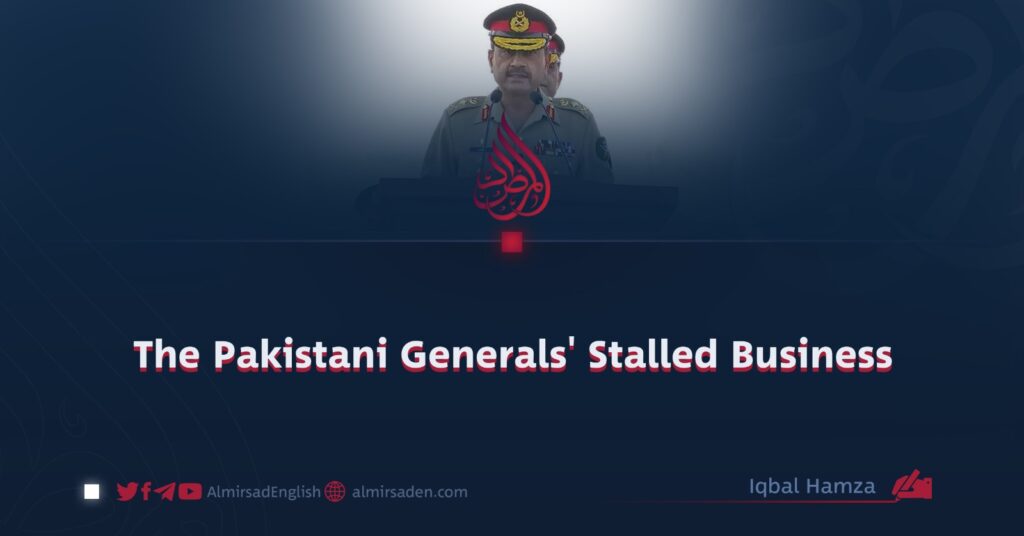
By Iqbal Hamza
From the very beginning of the Pakistani military, its main sources of funding and income were built around proxy wars, espionage, and interference in the affairs of other countries. The Pakistani military grew stronger during the war between Afghanistan and the Soviet Union, and later earned substantial profits from the supply routes during the U.S.-Afghan war.
In the eyes of Pakistan’s generals, if there is no instability in the region, especially in neighboring countries, they will face economic difficulties and even the risk of collapse. After they were deprived of the benefits and income they once drew from instability in Bangladesh and later in Kashmir, they turned their attention to Afghanistan. For nearly forty years, they profited enormously from Afghanistan’s turmoil, and it was under those very conditions that they also became a nuclear power.
But for nearly five years now, that business of the Pakistani generals has come to a standstill, because after four decades Afghanistan has come under the leadership of vigilant and clear-eyed rulers. The current leadership of Afghanistan is fully aware of every trick and deception used by the Pakistani generals and keeps a close watch on their every move.
Now the Pakistani generals are drawing up new plans for instability based on false hopes. They believe the project created under the name of Daesh will once again draw the world’s attention and perhaps bring them another round of financial assistance and concessions.
At the same time, they have gathered some former Arbakis (militias) of Afghanistan’s previous republican government, along with their commanders, in southern Pashtunkhwa and Balochistan. They are trying to reorganize them in the hope of creating fresh instability in the region. But this project is also facing failure because Afghanistan’s rulers are fully alert to it. Before these elements can reorganize or cross into Afghanistan, their activities are broken up before they can get off the ground.
The Afghan people, as well as the people of Balochistan and Khyber Pakhtunkhwa, are also far more aware than before. They no longer want the Pakistani generals’ business to continue in their lands. The generals are trying to keep these destructive elements, Daesh and the former republican Arbakis (militias), in Pashtun areas, but they have run into strong resistance from the local population. Some time ago, residents of Pishin and Kuchlak in Balochistan held demonstrations against this very issue and openly declared through the media that the presence of these people was no longer tolerable.
The Pakistani generals’ decades-old business, which has now ground to a halt, is about to lose even this last false hope. On one hand, Afghanistan’s current government is watching closely and will not remain silent in the face of such projects and sinister schemes. It will work to stop such plans before they can be put into action. On the other hand, the people of Balochistan and Khyber Pakhtunkhwa no longer want their land to be used against other countries, especially against the people of Afghanistan. That is why it is becoming harder with each passing day for the Pakistani generals to continue the policies that served them for so many years.