

By Akbar Jamal
The Pakistani people have been drawn into a peculiar psychological condition that can, in plain terms, be described as “political and military hypnosis.” It is a state in which individuals recognize their own suffering, losses, and exploitation, yet somehow lose the intellectual clarity and practical courage required to resist them.
To clarify this phenomenon, one might consider a familiar claim often voiced by atheists: that “religion is an opiate that distances people from reality.” According to this view, religious communities exist in a haze of imagined bliss, illusory heavens, and abstract hopes, detached from the concrete conditions of life and incapable of grasping earthly facts. This narrative is frequently deployed against religions in general and Islam in particular. From a Muslim perspective, however, such assertions amount to little more than intellectual distortion cloaked in prejudice.
Yet a bitter irony emerges. Today, this same notion of “intoxication” appears to describe political and state systems far more accurately than religious belief. For 78 years, Pakistan has been governed by a political and military structure that repeatedly demands sacrifice from its population while failing to provide basic services in return. The country’s economic condition stands as the most visible proof of this imbalance.
Record inflation, relentless increases in the prices of essential goods, electricity, and fuel, the steep depreciation of the rupee, and the ballooning burden of foreign debt have subjected the population, particularly the poor and the middle classes, to crushing pressure, in some cases driving individuals toward suicide.
Economic stagnation, along with the closure of factories and industrial facilities, has sharply expanded unemployment and poverty. The cumulative effect is stark: the prospect of living a dignified life grows more distant for ordinary citizens with each passing day.
This economic distress has been further aggravated by chronic political instability. Persistent power struggles, contested elections, the military’s repeated removal of elected governments, overt and covert episodes of martial law, and the absence of sustained, constructive dialogue have steadily weakened the foundations of stable and people centered governance. Rather than channeling its energy into alleviating public hardship, the state remains locked in contests for authority, the consequences of which fall squarely on the population.
The state of law and order is equally alarming. Armed violence continues in Khyber Pakhtunkhwa and Balochistan, while major cities have witnessed an escalation in street crime, personal feuds, theft, armed robbery, and open harassment of women. These developments have eroded citizens’ sense of safety almost entirely. A state once viewed as a guarantor of protection is increasingly perceived as a symbol of uncertainty and looming danger.
In such an environment, concerns over human rights have intensified. Restrictions on freedom of expression, prohibitions on political activity, enforced disappearances and arrests by military and intelligence agencies, and mounting pressure on the media are among the issues repeatedly highlighted by human rights organizations at home and abroad. Within this atmosphere, dissent is easily recast as treason, and questioning authority is labeled rebellion.
Government conduct and the humanitarian crises that follow only deepen public mistrust. Incidents such as those reported in Muridke, military operations in the Tirah Valley and other tribal regions, civilian casualties, and repeated waves of displacement have inflicted severe psychological, economic, and social damage on affected communities. Collectively, these experiences continue to widen the gulf separating citizens from the state and its security institutions.
Domestic turmoil has been compounded by international pressures. Strained relations with neighboring countries shaped by military policies, the cultivation of a perpetual war footing, and the harsh conditions imposed by global financial institutions have not only weakened perceptions of national sovereignty but have also shifted the heaviest burdens onto ordinary people.
Taken together, these realities paint a bleak portrait: Pakistan finds itself trapped in a multidimensional economic, social, and political crisis.
Yet despite all this, a question stubbornly remains. When conditions are so severe, why does the public remain silent? Why does it not confront these entrenched power structures or demand accountability? Why has it allowed itself to become such an easy target for predatory systems?
Tragically, the answers to these questions lie in the very claim made by atheists mentioned earlier. In other words, the same psychological aspect that atheists attribute to religion is evident here. That pattern operates in political form. Pakistan’s citizens have been conditioned by authoritarian rulers and military institutions to believe that without the existing army, dominant political parties, and prevailing order, the country would fracture, foreign powers would invade, its very existence would be threatened, and its fate would mirror that of Libya or Gaza.
The painful counter reality, however, is that for nearly eight decades these same institutions have inflicted economic hardship, political repression, diplomatic isolation, and at times direct physical devastation upon their own people.
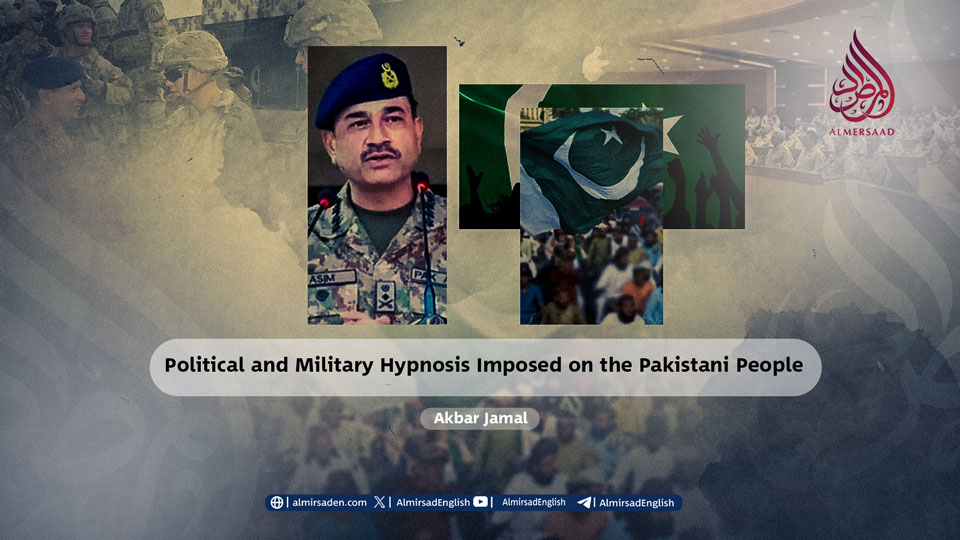
Put differently, the Pakistani nation has been indoctrinated to believe that its life is tied to the very Pakistani military that acts as its executioner. Citizens are encouraged to internalize the belief that their ultimate protector is the same military establishment that suppresses its own people. This is the essence of political and military hypnosis: a form of mental paralysis in which oppressed Pakistani Muslims witness abuses yet remain silent, discouraged from recognizing that genuine security arises not from coercive power but from justice, transparency, accountability, and an awakened public conscience.
Until Pakistan’s oppressed Muslims find the courage to transform their thinking, until they dare to raise the fundamental question, “Why do we tolerate all of this?”, no slogan, political party, or outside force will alter their destiny. History’s lesson is clear: when a people abandon independent thought and collective action, tyrants and oppressors step in to rule them, gradually dismantling their societies and consuming them from within.