
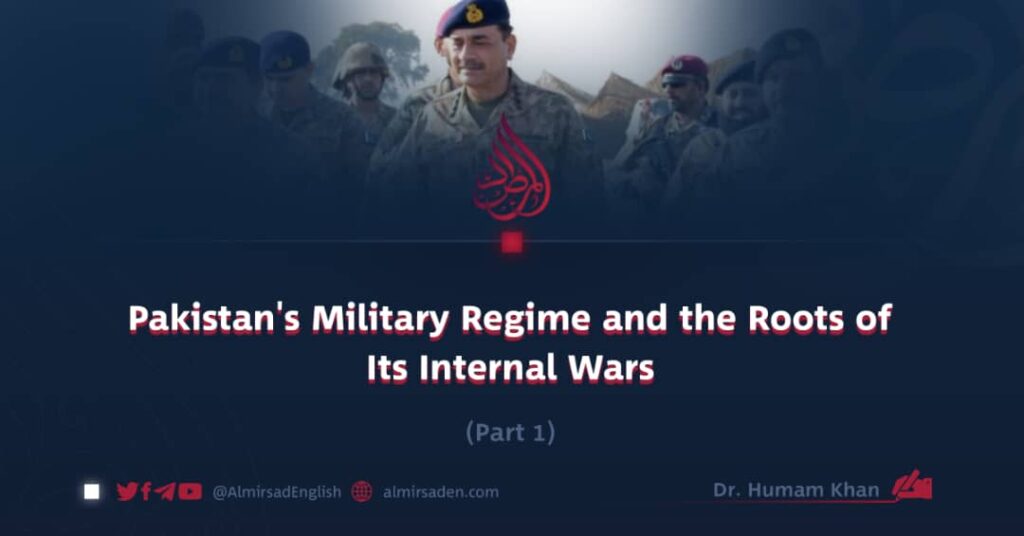
Part 1
By Dr. Humam Khan
State Power, Armed Movements, and Internal Conflict in Pakistan
The history of Pakistan’s internal security cannot be reduced to a tidy story about violence between the state and non-state actors. It is a far more tangled and enduring struggle, shaped by contradictory policies, regional power politics, the military’s entrenched dominance in public life, and decades of political and social marginalization. At critical junctures, the strategies pursued by Pakistan’s army and intelligence agencies not only destabilized the country from within but steadily corroded public trust in the state itself.
The excessive use of state force, constitutional overreach, enforced disappearances, extrajudicial killings, and collective punishment created precisely the environment in which armed movements flourished. Tehrik-i Taliban Pakistan (TTP), al-Qaeda, and several Baloch resistance organizations stand among the clearest examples. What follows examines these dynamics through a close look at state authority, counterterrorism policies, and the armed movements that emerged in response.
The Policy Background and the Growth of Militancy
Armed groups in Pakistan did not arise in a political or social void. During the Cold War and in the years that followed, state institutions, driven by regional calculations and strategic ambition, made indirect use of certain religious and armed networks. For long stretches, such groups were viewed as “strategic assets.”
It would be inaccurate, however, to claim that every militant organization was directly trained or supervised by the state. Many operated independently, motivated by ideological commitments, tribal loyalties, or local grievances. Yet their presence and activities frequently served state objectives in the short term, making them tolerable or even useful within official calculations.
At the same time, state institutions weakened political processes, avoided meaningful implementation of Islamic law, and inflamed divisions rooted in class, language, and identity. Over time, the very militant elements once considered manageable or advantageous transformed into serious domestic threats. What had once been tolerated gradually tightened into a noose around the state itself.
Instead of pursuing structural or intellectual reform, authorities repeatedly turned to coercion. The consequences followed a grimly familiar pattern: ordinary citizens absorbed the shock of sweeping military campaigns, collective punishments, and serious human-rights violations.
This contradiction, in which a state indirectly benefits from armed groups at one stage and later launches brutal military offensives against those same forces, has become one of the central drivers of Pakistan’s recurring instability and cycles of violence.
Tehrik-e Taliban, al-Qaeda, and Other Jihadi Groups: Origins and Expansion
Tehrik-e Taliban Pakistan and other militant organizations rose to prominence in Pakistan’s tribal belt, particularly in the former FATA, when the consequences of the Afghan war spilled directly across the border. Drone strikes, major military operations, mass displacement, humiliating treatment at checkpoints, and sweeping arrests bred anger and estrangement among local populations.
Numerous research studies indicate that the collapse of traditional tribal structures and the failure of state institutions to provide justice created an environment in which groups like TTP and al-Qaeda could find shelter and sympathy at the local level. These movements were therefore not merely ideological or religious reactions; they were also products of repression, opaque governance, and years of political exclusion.
Military Operations and Civilian Suffering
Across the years, Pakistan’s government turned repeatedly to large-scale military campaigns aimed at Islamist and jihadi groups. South Waziristan was engulfed by Operation Rah-e-Nijat. Swat followed under Rah-e-Rast. North Waziristan became the focal point of Operation Zarb-e-Azb (OZA), and later the entire country was swept into the broad, open-ended campaign branded Radd-ul-Fasaad.
Although carried out in the name of security, these operations inflicted heavy human, social, and economic costs on civilian populations.
From the state’s perspective, the objective was to eradicate terrorism and restore governmental authority. Human rights organizations and independent observers, however, have consistently argued that civilians paid the highest price. Hundreds of thousands were displaced. Entire districts were subjected to collective punishment. Homes and markets were destroyed. Thousands of Pakistani Muslims remain missing to this day, their families’ pleas receiving little official attention.
Policy Failures and the Persistence of Armed Movements
Over time, a grim consensus has emerged among analysts: brute force alone did not defeat militancy in Pakistan. Political reconciliation faltered, serious negotiations never gained traction, and long-neglected regions saw little genuine development beyond projects that looked impressive on paper but changed little on the ground. Enforced disappearances and extrajudicial killings continued, while accountability for security forces remained elusive. At the same time, public demands for the implementation of Islamic law, voiced since the country’s founding, were sidelined.
Under such conditions, groups like TTP either emerged or grew stronger, while in Balochistan, nationalist resistance movements expanded as well, each in its own way reflecting backlash against state coercion.
Balochistan, State Repression, and Baloch Resistance
In Balochistan, the record of state force is long, bloody, and deeply traumatic. Military campaigns, enforced disappearances, mass graves, and the unequal distribution of natural resources have produced profound mistrust and resentment among the Baloch population. The silencing of political voices and the branding of dissent as treason have only compounded the crisis.
Against this backdrop, Baloch resistance actions, including Operations Herof-1 and Herof-2, took shape. Baloch groups frame these acts as defensive responses aimed at protecting their existence and rights. The state, by contrast, views them solely through a security lens, a framing that deflects attention from the underlying causes. From an analytical standpoint, one point is striking: despite their ideological differences, jihadi organizations and Baloch nationalist groups converge on a single reality, the failure of state policy and an excessive reliance on force.
The challenge posed by TTP and other armed movements cannot be reduced to a problem of law and order alone. It reflects the accumulated effects of state policy, military dominance, abuses against civilians, and decades of political marginalization. When coercion becomes the default instrument, when accountability disappears, and when demands for Islamic governance are brushed aside, violence and instability follow with near certainty.
It is therefore difficult to understand why some commentators continue to express astonishment at reports of military abuse or policy duplicity, as though such patterns were novel or inexplicable. Anyone with even passing familiarity with the region’s history, particularly the record of Pakistan’s armed forces, would struggle to share that surprise.
In the parts to follow, I will seek through this series to demonstrate, through historical record and documented evidence, that today’s crises did not arise overnight. They represent the outcome of a long trajectory whose responsibility lies squarely with Pakistan’s military regime. In future parts, I will examine the army’s history in detail and trace how its policies and decisions have betrayed Pakistan’s Muslim population and the wider Muslim world.
Through this series, I aim to show readers that the roots of the current turmoil are embedded in decades of military policies and state practice.