
Salamat Ali Khan
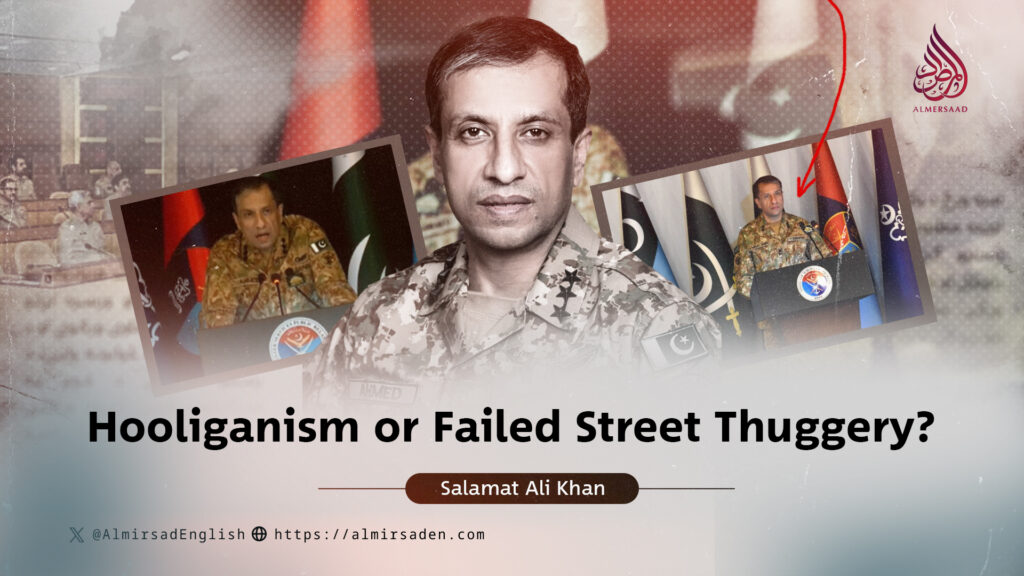
On Tuesday, the spokesperson for the Pakistani military held an extended press conference, inviting a large number of journalists to provide what he described as necessary clarification. Normally, such briefings are intended to inform the public about matters related to security and stability and to answer questions on behalf of the nation. Media representatives, speaking as the voice of the people, raise concerns and return with responses meant to reassure the public.
In such settings, military spokespersons typically speak in alignment with elected leadership, presenting themselves as part of a unified national structure and implying that everything taking place in the country is under a coordinated system of governance.
But the tone adopted on this occasion was dramatically different. Not for a moment did it seem that the speaker represented a credible institution. Every word, every phrase carried the unmistakable sound of a street-corner hooligan. He spoke like someone who, when confronted with a point of Islamic law, lashes out instinctively, as though religious guidance were a personal attack. Genuine legal rulings appear to him as threats, so he twists and reshapes his own inventions into something he can present as “religious,” dressing them up with a swagger that reveals his real intent. And should anyone question his actions, he instantly snarls back, just like the hypocrites of Madinah once did, “Are you accusing us? Do you object to what we do? We are only working for the betterment of others.”
Even those who politely remind him of his obligations, duties he has clearly failed to fulfill, are met with anger so fierce that he manages to distort even the plainest truth. With that in mind, consider yesterday’s performance: on one hand, he insisted that the military has no connection to politics, yet in the very same breath he launched a scathing critique of a provincial political party representing more than four million people and its leadership.
It felt less like an official briefing and more like a campaign rally, as if the party in question were a direct electoral rival and the man at the podium were not a uniformed spokesperson but a fiery opposition leader. One could imagine him, like such a leader, displaying videos of rival party leaders and mocking them in the harsh, blunt language of a street thug, short in stature but loud in menace, completely unbecoming of anyone in public service. When a journalist asked a sincere and fact-based question grounded in reality, his temper immediately flared. Instead of answering, he lashed out, saying whatever his tongue could formulate in the moment.
And when questioned about terrorism, when someone dared remind him of the military’s own responsibility and performance, he responded not with facts, but with intimidation. He hurled accusations at other nations or directed insults at the most respected political leader in the country, attempting to deflect blame from his own institution.
He claimed that “even the youngest child” knows the origins of terrorism. Yet on the same live broadcast, when ordinary citizens, those same “children of the nation,” called in and pointed directly to the real hub of terrorism, he brazenly dismissed them and pretended not to hear, behaving exactly like the hereditary street tough he sounded like.
A journalist raised the economic devastation caused by closing transit routes, damage that cannot be undone and that risks triggering a national crisis that will be impossible to contain once unleashed. The spokesperson replied arrogantly: “No, keeping the gates closed is beneficial.” Meanwhile, the entire country, from farmers to businessmen, is united in saying it is a disaster, that tens of thousands have lost their livelihoods. Yet he persisted: “No, it is beneficial.” The only benefit, clearly, is for him and those he represents, because a street thug only gets paid when chaos reigns.
The spokesperson then turned his attention to the neighboring government, dissecting its formation and policies in obsessive detail while making every possible effort to curb or undermine it. His tone and body language bordered on unhinged. When someone reminded him that he and his institution had celebrated the rise of that same neighboring government not long ago, he seemed to lose his senses entirely. What poured out of his mouth would embarrass not just a spokesperson, even a highway hustler would hesitate before uttering such filth.
Media experts say his goal was obvious: tarnish the neighboring government at any cost, even if doing so requires dragging himself into disgrace and abandoning every standard of professionalism.
Yet the question remains: Why? Why does he seem desperate to provoke hostility between two Muslim nations? What is the logic of manufacturing enmity by force? What hidden itch drives him to find pleasure in division?
Political analysts offer an answer: the institution he represents suffers from a tragic legacy. From the founding of Pakistan up to the present day, it has failed to accomplish anything worthy of national pride. Not only has it failed to deliver, it has repeatedly shed the blood of its own citizens, arresting, torturing, and killing them at every turn. As a result, deep public resentment now surrounds it. Mention the army, and people think not of honor but of brutality. Such anger creates the possibility that the people may one day demand a full reckoning, exposing everything the institution has long concealed.
To prevent this, and to portray itself as bold and fearless, the military periodically manufactures spectacle, staging one drama after another. On one hand, it terrifies the public through orchestrated disorder; on the other, it adopts the vulgar tone of street criminals, inadvertently exposing its true nature: this, nothing more, is the real face of the institution.
Their mindset now exhibits the same sickness found in Israel, the instinctive delight in humiliating Muslims and the desire to keep their own population perpetually distressed so that no one ever turns to question those in power. So long as the public remains trapped in crisis, those atop the hierarchy enjoy comfort and luxury. Instability in surrounding nations, especially Afghanistan, offers them opportunity: foreign funds flow in under a hundred names, and at home they play the role of benevolent protectors.
But the truth is now out. The world sees it. The people see it. And even the institution itself can no longer deny it. Which is why, stripped of credibility, it has finally taken refuge in thuggery, confusion, and outright madness.