
By Mufti Syed Jamal Afghan
Both Sahih al-Bukhari and Sahih Muslim relate an incident that has echoed across Islamic history. As the Messenger of Allah (PBUH) was distributing the spoils of war, a man named Harqus stood up and brazenly addressed the Prophet (PBUH), saying: “Fear Allah and act justly.”
The Messenger of Allah (PBUH) responded with visible anger: “If I were to act unjustly, then who on this earth would remain just?”
This insolence was unbearable to Hazrat Umar ibn al-Khattab (RA), the embodiment of courage and moral resolve. He requested permission to strike down the man for his audacity and gross disrespect. Yet the Prophet (PBUH), the Mercy to all creation, restrained him. Instead, he delivered a statement of enduring principle, one that was not merely directed to Umar (RA), but to the entire Ummah until the Day of Judgment. Through it, he warned of a group that would arise repeatedly throughout history, appearing under different names and disguises, exploiting the banner of Islam while plunging daggers into the hearts of Muslims.
The Prophet (PBUH) declared: “This man is not alone. From among his companions will come people whose prayers and fasting will make you regard your own deeds as insignificant. Yet they will depart from the religion just as an arrow passes through its target.”
This prophetic warning has materialized with chilling precision in every era of Islamic history. Its fulfillment is so clear that denial is no longer possible, nor can doubt honestly be sustained. From the era of the Rightly Guided Caliphs, through the time of Amir Mu’awiya, the Umayyads, the Abbasids, the age of Salah al-Din Ayyubi and Nur al-Din Zangi, the Ottoman Caliphate, and now in the era of the Islamic Emirate of Afghanistan (IEA), the followers of Harqus have consistently resurfaced. They have appeared under different labels, with different outward forms, yet always with the same function: tearing apart Muslim ranks from within. They spill the blood of the people of the Qiblah and stand as a black stain upon the sacred forehead of Islam.
Such is the moral depravity of their actions that even Jews and Hindus have recoiled from them in shame throughout history. The reason is plain: they have reduced Islam and its teachings to a grotesque caricature. They invoke the name of Islam endlessly, yet make no sincere effort to understand its substance. Instead, they invent interpretations driven by their own corrupted impulses, distorting the faith to legitimize their errors and obscenities. Their arguments collapse under even the most basic scrutiny of reason.
When the Battle of Jamal (also known as the Battle of the Camel) came to an end and reconciliation was achieved between Hazrat Ali (RA) and Sayyidah Aishah (RA), Hazrat Ali (RA) escorted the Mother of the Believers back to Madinah with full honor and dignity. At that moment, the architects of fitna, followers of Dhul-Khuwaisirah, erupted in protest. They demanded to know why A’ishah (Allah forbid) had not been taken captive. Their logic was crude: if fighting her was permissible, why was enslavement not?
In response, Haider al-Karrar (RA) delivered a devastatingly rational answer. The Qur’an, he reminded them, declares the wives of the Prophet (PBUH) to be the Mothers of the Believers. “Are you prepared,” he asked, “to see your own mother taken captive and enslaved?”
In that moment, he simultaneously exposed their ignorance of religion and mourned the poverty of their intellect. Yet these simple truths could not penetrate minds sealed by arrogance and stupidity. Emboldened by their ignorance, they expanded their accusations to include other Companions of the Prophet (PBUH), most notably Hazrat Abu Bakr and Umar (RA).
Later, when Hazrat Ali (RA) agreed with Amir Mu’awiyah (RA) to appoint arbitrators from both sides to resolve their dispute, the same group erupted once more. “No,” they cried, “judgment belongs only to the Qur’an, not to men.”
This demand was neither profound nor principled; it was hollow posturing. Sayyiduna Ali (RA) responded not with rhetoric, but with an unforgettable demonstration. He ordered hundreds of men to stand before them holding pages of the Qur’an. Then he proclaimed aloud: “O Qur’an, speak and judge between us!”
The crowd stood stunned. How could pages speak? Hazrat Ali (RA) knew they could not. His purpose was to expose the absurdity of their claim. If the Qur’an is to judge, then it is the people of the Qur’an, the scholars endowed by Allah Almighty with understanding, who must interpret and apply it. And who among the Muslims was more qualified than the Companions, particularly Hazrat Ali himself? But ignorance had veiled their minds, rendering them incapable of grasping even the most elementary truth.
Among the defining traits of the followers of Harqus, those foretold by the Prophet (PBUH), is their audacity in spilling Muslim blood, born of shallow religiosity and self-invented interpretations of faith. Their hypocrisy is staggering. They would refuse to eat a single date fallen on the roadside, fearing sin or infringement of another’s rights. Yet with the same hands, they slaughter the most righteous servants of Allah with a cruelty that defies human comprehension.
When they captured Abdullah, the son of the noble Companion Khabbab ibn al-Aratt (RA), his crime was simple: he refused to denounce Hazrat Ali (RA). For this, they bound him to a tree, tortured him, and slaughtered him like livestock beside a river. They then seized his pregnant wife and, without hesitation or remorse, tore open her belly and murdered her.
Yet in the midst of this barbarity, when a date fell from a tree and one of them ate it, another rebuked him sharply: “You consumed it without the owner’s permission; it is haram!” When one Khariji of them struck a pig, another demanded compensation and found its owner and personally paid its value. Such is the moral schizophrenia of this creed.
Hazrat Ali, Amir Mu’awiyah, and Amr ibn al-As (RA) were among the most eminent Companions of the Prophet (PBUH), pillars of Islam, leaders of its conquests, and figures intimately connected to the Messenger of Allah. Yet these extremists conspired to assassinate all three. Their plot succeeded only once, resulting in the martyrdom of the Prophet’s son-in-law and the Lion of Allah, Hazrat Ali (RA).
The hallmark of this polluted ideology is relentless accusation. Disagreement, no matter how minor, is transformed into charges of apostasy and shirk. There is no concept of gradation in sin. Either one conforms to their distorted vision, or one is branded an unbeliever. When invited to join Hazrat Ali (RA), they replied that he must first repent from shirk, then embrace Islam anew.
This, despite the fact that the Messenger of Allah (PBUH) testified to Hazrat Ali’s faith, declared him a criterion between truth and falsehood, and taught that love for him is faith while hatred toward him contradicts it. Yet these intellectual paupers, armed with slogans but empty of knowledge, dared to lecture the very Gate of Knowledge with a misused slogan.
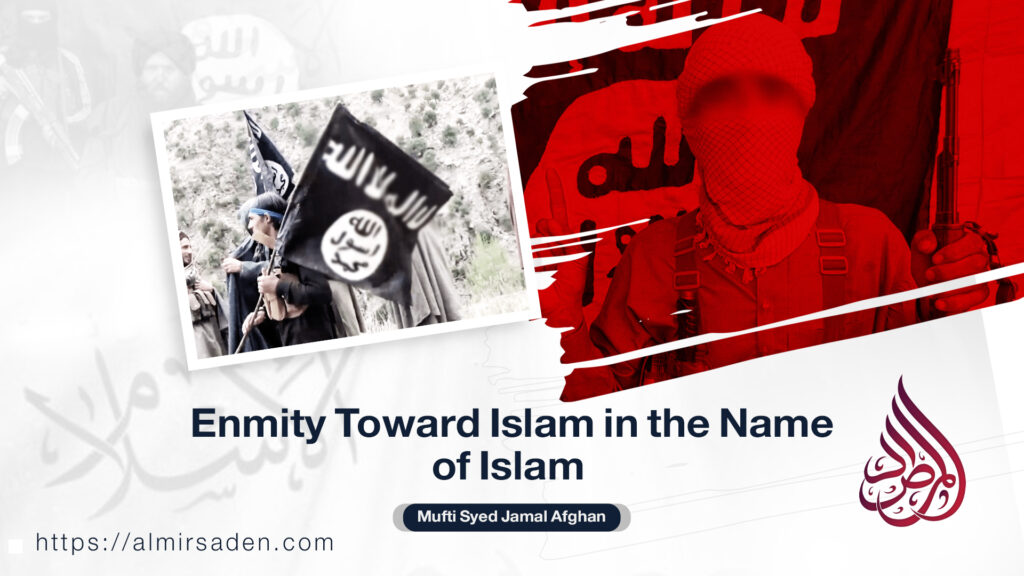
Examine today’s followers of Harqus and Dhul-Khuwaisirah. Their methods are unchanged. In Afghanistan, after decades of sacrifice and the blood of over a million martyrs, an Islamic system has been reestablished. Its leader, the Amir al-Mu’minin (may Allah preserve him), publicly invites accountability, declaring that any deviation from Islam should be corrected. Yet it is precisely this system that these Harqusi and Khuwaisiri elements oppose, aligning shamelessly with foreign powers. For them, a pig holds greater value than the son of a Companion.
Since Allah Almighty granted victory to the IEA and humiliated global disbelief through its hands, these factions have taken up arms. They have bombed mosques, targeted madrasahs, assassinated scholars, and hunted leaders and commanders who remain thorns in the eyes of disbelief.
Their most recent atrocity occurred in Shahr-e-Naw, Kabul, where seven innocent Muslims were burned alive in a hotel explosion. They proudly claimed responsibility, then compounded their crime by declaring the victims apostates. Even shame has abandoned them.
Scholars and historians agree: these groups have always been instruments used to undermine Islamic strength. When Islamic conquests shook the foundations of disbelief during the era of the Rightly Guided Caliphs, enemies found no answer except to deploy these fools under Islamic disguise, turning Muslims against one another.
This pattern has repeated itself throughout history. Today, as the Islamic system reemerges in Afghanistan, enemies once again exploit these elements. Certain neighboring states, too, felt a deep internal unease. When they found themselves unable to achieve their objectives by their own means, they followed their familiar course: exploiting these fools as instruments to advance their agendas.
At a time when Palestine burns, when the Ummah longs for unity, and when hope has turned toward the IEA, these wretched figures serve foreign interests while attacking Muslims. Had they possessed sincerity, the battlefield of Palestine lay open before them. But having sworn hostility toward Islam itself, they direct all their violence against the weakest among the believers, proving once again that theirs is enmity toward Islam in the name of Islam.