
Part 5
By Khalil
ISIS and the Manipulation of Fiqh for Power
When we examine and analyze ISIS’s fiqh rulings and their extremist religious interpretations, we realize that we are not dealing with a normal, scholarly, or legitimate system of Islamic jurisprudence. The key question that arises is: what is the ultimate purpose behind all these fabricated fiqh rulings, the construction of pseudo-legal injunctions, and extremist interpretations of religion?
The answer should not be sought in the Qur’an, the Sunnah of the Prophet (PBUH), or the practices of the righteous Caliphs and mujtahid imams. Rather, it must be found in ISIS’s logic of power-seeking and ambition for dominance.
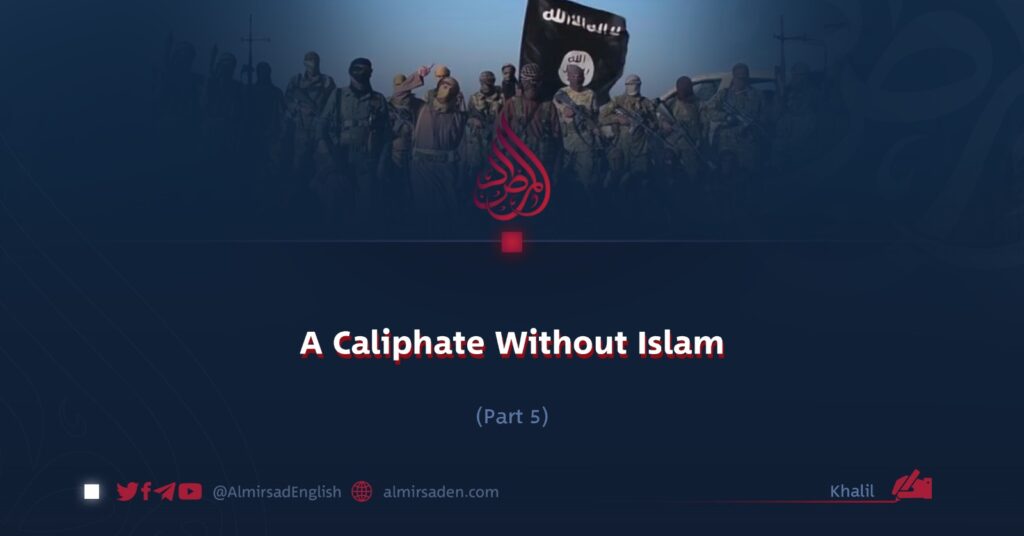
What ISIS called “fiqh” during its campaign of attacks was, in reality, a collection of fabricated and distorted rules created for a single purpose: to establish, maintain, and expand the rule of a particular group under the name of a “caliphate.” In truth, this pseudo-fiqh was not a path to correct understanding of religion; rather, it was a tool for a power-driven ideology.
Their distorted fiqh can be analyzed in three interlinked stages:
In the first stage, ISIS needed to legitimize and even sanctify its extreme violence through the falsification and distortion of religion and fiqh. To achieve this, they repeatedly redefined the concept of “jihad” in such a way that no boundaries remained between military and non-military targets, defense and offense, or even between Muslims and non-Muslims.
Within this framework, killing people was labeled as “retribution,” terrorism was considered the enforcement of legal limits, and the occupation of cities was called an Islamic conquest. This redefinition, on one hand, provided recruited individuals with a religious and emotional incentive, presenting their crimes under the guise of worship, and on the other hand, sent a message to the outside world that this group does not recognize dialogue or reconciliation and only understands the language of violence.
In the second phase, the ISIS group was compelled, for its own survival, to create a fully obedient and unified society. The most important tool for achieving this goal was widespread takfir. The group claimed that only its members were true Muslims, while everyone else, from Shia and Sunni who disagreed with them, to Sufis and non-Muslims, was placed in the ranks of disbelief. In doing so, they established a rigid and violent identity boundary between themselves and others.
Based on this ideology, ISIS followers were trapped in a kind of mental siege, a world in which everyone else was an enemy, and the only path to salvation was complete obedience to the group’s leaders. As a result, individuals’ previous identities, such as nationality, ethnicity, and even traditional family religiosity, were erased, and blind sectarian loyalty was elevated to the highest virtue. Within this climate of violence, any question or criticism was considered an act of betrayal.
In the third stage, when ISIS took control over specific territories, it needed a mechanism to govern these areas. Strict rules regarding women, collective punishments, arbitrary financial regulations, and harsh security measures were the tools through which they sought to establish the laws of a police and military-style government.
These laws had several key characteristics. First, they allowed no flexibility or room for interpretation, and the authority for complete interpretation rested solely with the group’s military leaders. Second, they brought all aspects of people’s lives under strict control. Third, by publicly enforcing severe punishments such as executions, flogging, and amputation, their primary aim was to spread general fear and prevent any form of dissent or disobedience. Here, jurisprudence and law were not used for justice but as tools to consolidate power through terror.
In conclusion, it can be said that ISIS’s jurisprudence, despite claiming a return to the righteous predecessors (Salaf), was in reality a modern and political phenomenon. This jurisprudence represented a dangerous combination of takfiri extremism, contemporary organizational methods, and severe authoritarianism. Its governing logic was the logic of survival and expansion for a specific organization and group, not the logic of religious piety or legitimate religious reasoning. Even actions such as sexual slavery or the destruction of historical artifacts did not stem from religious texts, but rather from the psychological and political needs of the ISIS group.
Therefore, confronting ISIS and similar movements cannot be achieved solely through military force. This confrontation must be twofold: on one hand, a security struggle to dismantle their physical structures, and on the other, an intellectual and cognitive struggle to expose these violent and power-seeking entities. Their ultimate defeat will occur when concepts such as Jihad, Caliphate, Sharia, and the Ummah are freed from the clutches of those who distort them, and this narrative of violence is openly rejected and condemned in the minds and consciences of Muslims.