
By Khalil Ahmad
In the 20th and 21st centuries, the largest crusade waged against the Muslim world was launched under the deceptive banner of the “war on terror.” Beneath its polished slogans of security and human rights lay a far more sinister project: the plunder of Muslim wealth, the erosion of Islamic values, and the occupation of Muslim consciousness. With time, what was once concealed behind rhetoric became unmistakably clear to the Ummah.
The consequences of this war, which is still unfolding, are written in blood and disappearances. Fear was deliberately cultivated among Muslims; hundreds of thousands vanished without trace; tens of thousands were imprisoned; and millions were killed. The end result was the occupation of vast stretches of the Islamic world, the desecration of sacred sites, and the artificial creation of political entities imposed upon Muslim lands, states that had no historical or moral legitimacy.
This pillage was not carried out blindly. First, pliant regimes were installed across the Muslim world, each tailored to serve foreign interests. Then leaders were selected who had perfected the craft of selling faith for power, men experienced in betrayal and fluent in submission. Alongside this, distrust and division were systematically sown among existing Muslim rulers. The Ummah was fractured deliberately, and poisons were released into its body politic, poisons whose effects will linger for generations, long after their architects have vanished.
To serve their crusader and Jewish masters, slave armies were assembled, forces prepared for every act of service and submission. They pronounce La ilaha illallah with their tongues, while their leaders parade themselves as guardians of Islamic sanctities and role models for the Ummah. The tragedy is not merely their hypocrisy, but the depth of their moral decay. Possessing weapons, wealth, and authority, they continue to sell their faith with enthusiasm. Their consciences are so thoroughly extinguished that even the open warfare waged by their masters against Islam and Muslims fails to stir a flicker of shame.
Among the so-called Islamic states complicit in this war against Islam stands the Pakistani state, its corrupt and mercenary army, and its tyrannical establishment. This army has made itself perpetually available for service to crusader powers, particularly the West. In its oppression of Muslims in the lands of India and Khorasan, it has played a role eerily mirroring that of Israel in the heart of the Middle East.
Since the British laid the foundations of this regime, its mercenary army has repeatedly fed on Muslim blood and violated Muslim honor. Yet among all the atrocities it has committed, the cheapest currency in its wars has been helpless women, women who carried no weapons, posed no political threat, and held no power. Their only crime was their vulnerability. Even so, they were not spared from being traded, sold, and sacrificed in political bargains.
From Lal Masjid, hundreds of female religious students were humiliatingly handed over to the Americans. Dozens of Baloch and Pashtun Muslim sisters remain disappeared to this day. From among these victims, one story stands as a devastating symbol of this machinery of betrayal.
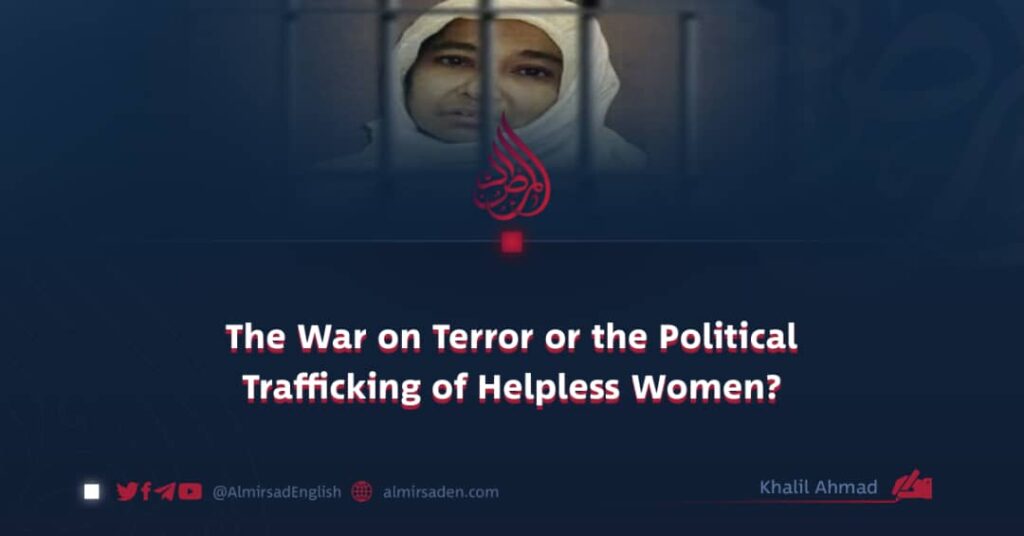
Dr. Aafia Siddiqui, a Pakistani citizen and resident of Karachi, was an accomplished academic. She completed her higher education in the United States, earning a bachelor’s degree in biology and a PhD in neuroscience. After her studies, she returned quietly to Karachi, living an ordinary life far removed from politics and militancy.
In 2003, she was suddenly abducted in Karachi along with her three young children by Pakistan’s intelligence agency, the ISI. She was first kidnapped by Pakistani intelligence agents and later handed over to the Americans. How long she was held by Pakistani authorities, whether days, months, or years, remains obscured. What is known is that she was eventually transferred to the U.S. military prison at Bagram.
For years, Dr. Aafia Siddiqui vanished from the world. Her family searched in desperation while the army and intelligence agencies feigned ignorance. Yet she was imprisoned in Bagram, the fortress of the great pharaohs of the time, detained alongside her children under the designation “Prisoner 650.” Her existence there came to light only when released detainees testified to the presence of a Pakistani Muslim woman in the prison. Human rights activists and international organizations were eventually forced to acknowledge the case.
In 2008, she resurfaced in Ghazni, Afghanistan, where authorities claimed she had links to al-Qaeda and was in possession of sensitive documents. A shooting incident followed. Despite being physically unable to stand, U.S. forces alleged that Dr. Aafia seized a weapon from an American soldier and opened fire. No American soldier was injured or killed. Aafia herself, however, was shot.
She was transferred once again, from Ghazni to Bagram, and then to the United States.
In 2010, a U.S. court in New York sentenced Dr. Aafia Siddiqui to 86 years in prison for allegedly attempting to kill American soldiers, despite her physical condition and the absence of casualties. She remains imprisoned today in a U.S. federal medical center. Indeed, we belong to Allah, and to Him we shall return.
Dr. Aafia Siddiqui was an educated, dignified Muslim woman, known for her commitment to Islam and her role as a committed believer and caller to Islam. Yet political bargaining delivered her into the most brutal prisons of the infidels. Her case exposes the reality behind the “war on terror,” a campaign in which apostate and mercenary regimes trafficked Muslim women for political gain.
An army that reduces women to bargaining chips has already indicted itself. This is not merely a story of irreligion. It is a damning testament to moral collapse, shamelessness, and the systematic violation of honor.