
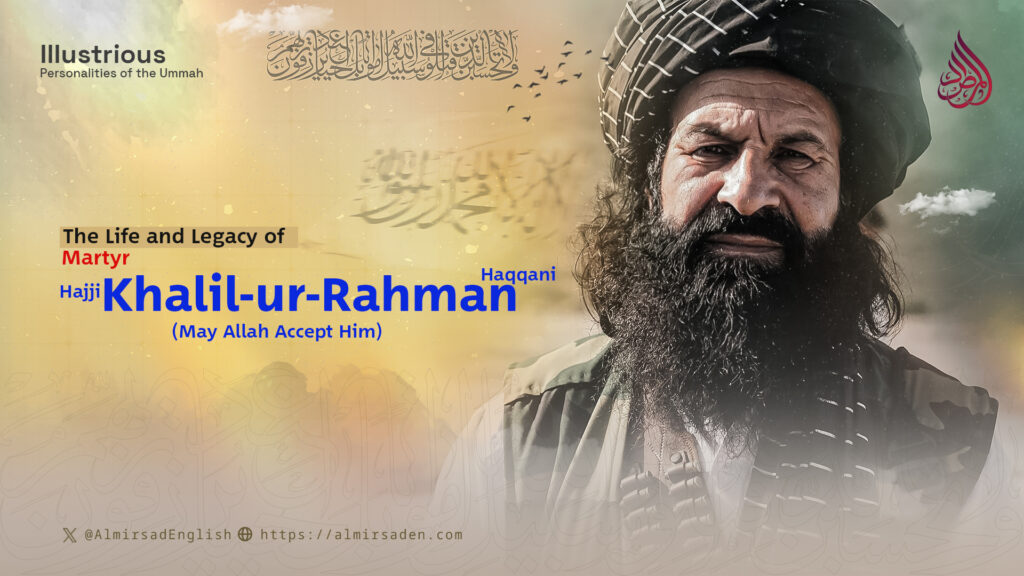
Throughout history, some deaths signify far more than the loss of a single individual. They expose the deepest contradictions of their era and lay bare the most painful wounds of a nation. The martyrdom of Hajji Khalil-ur-Rahman Haqqani stands as one such moment. For years, global powers pursued him and placed a bounty of millions of dollars on his head. Yet in the end, he was not killed by those external forces, but by individuals who claimed to act in the name of Islam while turning their weapons against Muslims themselves. History records such acts among its darkest examples of treachery.
When a Muslim raises his hand against another Muslim, he first destroys his own understanding of faith and then strikes at the very lifeblood of the Ummah. The Daeshi Khawarij, who cloak themselves in religious language, deepened the suffering of an already wounded community. What foreign enemies failed to achieve over decades of war, they accomplished in a single, misguided act. This was neither jihad nor courage. It was a barren deviation from the path in which Allah the Almighty has forbidden the unjust killing of any soul, and doubly so the killing of a Muslim Mujahid. Such a deed, no matter what banner is raised to justify it, is the gravest form of betrayal.
Let us now return to the life of this steadfast and courageous Mujahid who emerged from the crucible of fire and war, only to be martyred by the Daeshi Khawarij. Below is a brief account of his life, from his birth to his martyrdom.
1. Birth and Education
Hajji Khalil-ur-Rahman Haqqani was the son of Khwaja Muhammad and the grandson of Ali Badshah. He was born around sixty-nine years ago in Karezigi, a village in the Gerda Serai district of Paktia Province, in the home of his maternal relatives. Ethnically, he was a Pashtun from the Zadran tribe, belonging specifically to the Mizai Sulaiman Khel clan.
He did not attend school, college, or madrasa in any formal manner. Yet from childhood to his final years, his education unfolded across migration, hardship, and struggle. From an early age he was trained in endurance, patience, courage, and sacrifice. At the age of five he began learning the Holy Qur’an from his mother and completed basic religious studies with the imam of the local mosque. He later studied under Mawlawi Muhammad Umar in Karezigi, Gerda Serai.
Under the guidance of his elder brother, the distinguished Mawlawi Jalal-ud-Din Haqqani (may Allah have mercy on him), he studied intermediate religious books. His education continued during his family’s migration to Pashtunkhwa, where he also received short-term medical training to treat wounded Mujahideen. When the Soviet invasion began, he devoted his entire being to armed struggle and jihad. Thus, his formal learning ceased, but his real education never stopped. Through constant engagement with people and tribes, he absorbed a deep understanding of social customs, public affairs, and political matters, reaching a level of insight that many highly educated individuals could not match.
As the author of The Esteemed Reformer, the Great Ghazi writes: “Hajji Khalil did not possess higher education, yet his clear intellect and innate political genius allowed him to understand the nature of enmity. During the Afghan-Soviet war, when he spoke with enemy officers by radio, he would not insult them. Instead he would calmly say, ‘You do not even understand your own evil.'” He was fluent in Pashto and Dari, conversed comfortably in Urdu, and understood Arabic.
2. Political Struggle and Jihadi Background
The spirit of jihad, fortitude, and defiance that characterised Hajji Khalil-ur-Rahman Haqqani was an inheritance from his ancestors. His forefathers had fought the British in Zurmat, Paktia, and Logar, and after fierce battles, they emerged victorious. The weapons they seized from the British were later used by Mawlawi Jalal-ud-Din Haqqani in the jihad against the Soviets.
After the coup of Daoud Khan, when communists were placed in influential positions and began persecuting Islamists, the elders of the Haqqani family, led by Mawlawi Jalal-ud-Din Haqqani and Hajji Muhammad Ibrahim Haqqani, convened major assemblies with scholars and tribal leaders throughout Greater Paktia. Together they launched political and jihadi mobilisation against the communist onslaught.
The communist regime attempted to assassinate the Haqqani elder brothers but failed. Through tactical planning and with the support of local communities, the family was moved from one secure area to another. They sought refuge in Shamal Valley and later the Garoubi mountains, but after a fifteen-day siege, they were forced to migrate.
In 1354 of the solar calendar, after five days of walking, Hajji Khalil-ur-Rahman Haqqani and his family migrated to Datta Khel in North Waziristan and later settled in Miran shah. Alongside Mawlawi Jalal-ud-Din Haqqani, he remained active on the frontlines against both the communists and the Soviet army.
During the jihad against America and NATO, he again stood at the forefront. On 15 December 2003, he was captured alive in a joint operation by American and Pakistani forces and accused of involvement in an attempt on the life of General Pervez Musharraf. He spent four years in harsh imprisonment and was later detained again in Peshawar for about a month.
In 2009, the United Nations moved to place him on its sanctions list. On 9 February 2011, the U.S. Treasury Department designated him under Executive Order 13224 and announced a reward of five million dollars for his capture. Nevertheless, he did not relent for a moment and continued his struggle against occupation until the last American soldier withdrew from Afghanistan.
The stories of his courage and victories remain engraved in the memories of his comrades, and there is no example of defeat associated with his name.
3. Participation in Councils and Mediation
Hajji Khalil-ur-Rahman Haqqani possessed profound understanding of tribal customs, public affairs, and conflict resolution. This wisdom flowed from his lineage. His grandfather had been a respected tribal elder, and after his passing, leadership continued through his uncle, Gul Muhammad Khan.
He accompanied the Great Reformer and Great Ghazi, Mawlawi Jalal-ud-Din Haqqani, in countless jirgas and councils, bearing great hardship to resolve public and tribal disputes. His influence extended beyond Greater Paktia, making him a widely respected figure in national reconciliation.
During the civil wars, he and Haqqani Sahib made unforgettable efforts for peace, approaching all sides, mediating between factions, and cooling the flames of conflict. Anyone familiar with Afghanistan’s councils and mediation traditions knows the contributions and influence of the martyred Haqqani.
4. Character and Skills
Hajji Khalil-ur-Rahman Haqqani was the embodiment of piety, patience, forbearance, and courage. His personality united gentleness with firmness. He was naturally inclined to help the needy, spoke with clarity and purpose, and had exceptional experience in military matters.
Mustafa Hamid, an Egyptian writer and journalist who observed him during the Soviet invasion, wrote in his book On the Roof of the World: “Khalil-ur-Rahman Haqqani was unrivalled in targeting with tanks. He was a brave Mujahid who broke the enemy’s front lines. He not only mastered tank operation and aiming but also understood their technical details and mechanics.”
His humility and compassion were well known. He shared his food with others, and if he lacked money to assist the poor, he would borrow to help them. He was affectionate toward children and highly valued their love. His reputation for extinguishing conflict and uniting tribes earned him great respect throughout the country.
Allah had gifted him and his family with the noble quality of forgiveness. When he captured an enemy in direct combat, he would follow the example of Haqqani Sahib by granting pardon, assuring safety, clothing them, giving them money, and escorting them out of danger with his Mujahideen. Many of these individuals later fought alongside him.
He never turned anyone away, regardless of his responsibilities. In his final years, as Minister for Refugees and Repatriation, he kept his office open to all people and refused to return home until he had signed the last petition of the day.
He excelled in establishing and maintaining relationships, even with individuals inside enemy political and military circles. Through these networks he often received advance information about planned operations and prepared countermeasures.
After the Islamic Emirate of Afghanistan (IEA) regained control, he worked closely with Hajji Wafa, then Governor of Kandahar and now Governor of Mazar-i-Sharif, to secure the peaceful surrender of Kandahar, Nangarhar, Kunar, and several other provinces. Through organised communication with officials of the former government, he prevented war, destruction, and bloodshed, and personally facilitated the safe return of senior officials to their homes.
5. Responsibilities
From his early youth until the final moments of his life, Hajji Khalil-ur-Rahman Haqqani bore a wide range of responsibilities, each carried with dedication and sincerity. His services spanned military, political, social, and humanitarian fields, reflecting a lifetime committed to the defense and welfare of the Afghan nation and the Islamic Ummah.
He oversaw the training and jihadi programs of the Mujahideen during the period of migration and led the committees responsible for addressing the problems of Afghan refugees. He also headed the council established among political opponents and reformers during migration, and he served as the general supervisor of the martyred Sulaiman Shah Zaghrawal camp. Throughout the jihad, he led Mujahideen forces in Khost, Paktia, Paktika, Ghazni, Logar, and Jalalabad, and during the conquests of Khost and Paktia he held military responsibility over seven factions.
He was a member of the Mujahideen Central Council during the rule of Dr. Najibullah, and during the civil wars he served on the reform council entrusted with resolving internal disputes, acting as both military and political head of a restraining force. He represented his organization in key political moments, including the meeting of the seven organizations regarding the transfer of power from President Sibghatullah Mujaddidi to Professor Burhanuddin Rabbani, as well as in discussions with the United States Secretary of Defense and his accompanying delegation. He also served as a representative of the tribes of Paktia Province in the Ahl al-hall wal-aqd Council (reconciliation council).
After the defeat of the Soviet occupation, he became a member of the reconciliation council established under the leadership of the Imam of the Kaaba to heal rifts among the jihadi leaders. During the first period of the IEA, he held responsibility for the Republican Guard and Khwaja Rawash Airport, and he commanded the Mujahideen front on the northern fronts. Prior to this, he had already commanded a Mujahideen front during the fourteen-year jihad that followed the Saur Coup.
During the American invasion, he commanded a Mujahideen group and, following the defeat of the occupation, he played a key role in establishing communication with Kabul administration officials to ensure the peaceful surrender of military equipment and to prevent unnecessary bloodshed. Throughout his life, he often carried the burden of guardianship for the elder Haqqani Sahib, may Allah have mercy on him, representing him in numerous political and military meetings.
After the reestablishment of the IEA, he served as the Minister for Refugees and Returnees. In this position, he supervised the resettlement of hundreds of thousands of Afghan refugees who had been forcibly deported by Pakistan in the year 1402. During his three-year tenure, he traveled to Saudi Arabia, the United Arab Emirates, Pakistan, and Iran in order to resolve the difficulties faced by Afghan refugees and returning families.
6. Cultural Efforts
Hajji Khalil-ur-Rahman Haqqani possessed a deep appreciation for books, history, and media, an affinity inherited from his family. Although the family produced relatively few writers, it gave rise to many individuals who contributed to cultural preservation and played an active role in safeguarding the historical record of the Afghan jihad. Under his guidance, and with the leadership of the late Mawlawi Muhammad Yunus Khalis, biographies of the martyrs of the Islamic Party were compiled, along with accounts of the struggles of notable martyrs who resisted the American invasion. These works are expected to be published along with their personal memoirs and notes.
His cultural commitment was evident in his daily habits and in the generosity he extended to others. He regularly listened to radio and television news, followed political debates, and read newspapers and magazines. He supported authors by ensuring their books were published and personally donated books to various libraries. He consistently provided media outlets with reports of his activities and held special meetings with journalists. During his travels to the provinces, he would bring media representatives with him, treating them with warmth and respect, inviting them to his table, and hosting gatherings in their honor.
In every age the Khawarij reappear to reopen the wounds of the Ummah. Their outward displays of religiosity mask hearts filled with darkness, and to them the blood of a Muslim carries no more weight than a drop of water. Scholars have long said that the Khawarij flee from the gentle aspects of truth while keeping their swords sharpened against the believers. They have always struck the Ummah with the dagger that clears the path for its enemies, leaving the Muslim Ummah mourning one hero after another. They martyred another esteemed figure of the Ummah.
7. Martyrdom
At last, this distinguished figure of the Islamic Ummah, a man whose name had been placed on the United States blacklist, a devoted Mujahid upon whose head millions of dollars in bounty had been set, was martyred by the sworn enemies of Islam, ISIS. They carried out what Islam’s declared enemies had begun but had failed to complete.
On December 11, 2024, at approximately 1:30 in the afternoon, Hajji Khalil al-Rahman Haqqani was martyred in a suicide attack inside the Ministry of Refugees and Repatriation (MoRR). The attack was carried out by the Daeshi Khawarij.
His funeral was held the following day, on Thursday, December 12, in his ancestral homeland. It was conducted with solemn traditional rites, and he was laid to rest in the new cemetery of Zarghun Rughah. May Allah illuminate his grave.
O great martyr of Islam,
You lived with honor, and you departed with honor. You etched your courage and steadfastness into the history of Islam with your own blood. You became among those included in the glad tidings conveyed by the Messenger of Allah (PBUH) who said that glad tidings to the one who kills the Khawarij or is killed by them. Martyrdom is a profound blessing, granted only to the most fortunate among mankind.
You devoted your life to defending the sacred religion of Islam. In truth, you were not martyred only on this final day. You were already a martyr walking upon the earth, awaiting the moment when that honored decree would be fulfilled. You were killed by the same kind of people who murdered the noble Companion of the Prophet, Hazrat Uthman, may Allah be pleased with him, while he was reciting the Holy Qur’an and whose pure blood fell upon its sacred pages.
You are a martyr of elevated rank, one upon whom Allah has bestowed His favor. We follow the path you walked, and we are content that both our life and our death remain upon that path, with honor and devotion.