
By Dr. Farhan
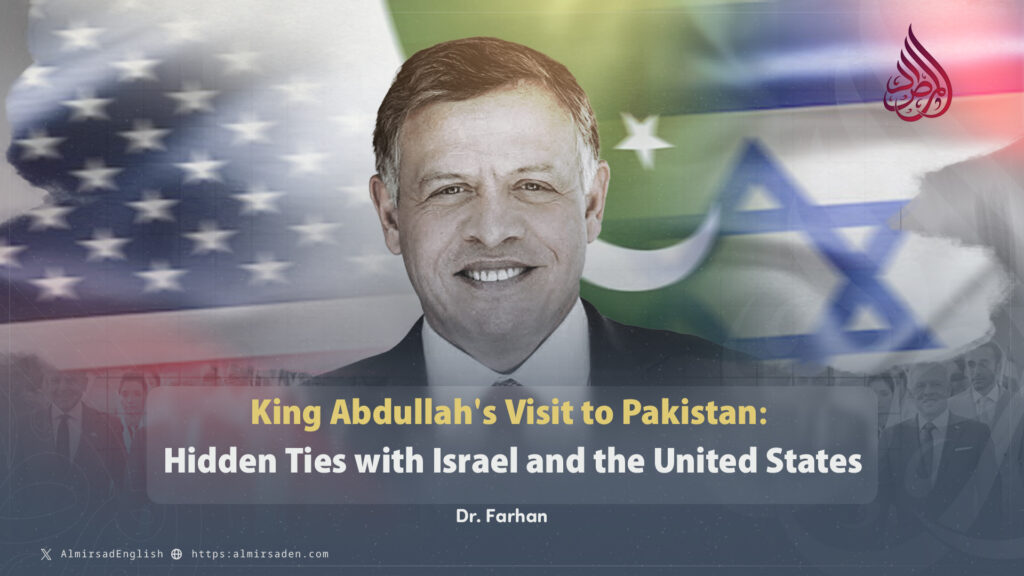
A few days ago, Jordan’s King Abdullah II arrived in Pakistan for a two-day official visit. To many, he is not seen simply as the ruler of a Muslim nation, but as an unofficial emissary of the Zionist regime.
Analysts maintain that his visit to Pakistan is not unrelated to recent events and Pakistan’s disputes with the Afghan government. Many argue that the disruptive activities unfolding in the region are not driven by domestic motives but are commanded and orchestrated from outside Pakistan.
Pakistani Senator Maulana Atta-ur-Rahman has voiced a similar assessment, stating that Pakistan’s recent incursion into Afghanistan was ordered by foreign powers. He insisted that the conflict with Afghanistan does not reflect the aspirations of the Pakistani people but is instead part of a broader script written by major powers and carried out by Pakistan’s military leadership.
The king’s arrival is also viewed as further evidence of the quiet relationship Islamabad maintains with Israel. This perception gained even more traction after an Israeli representative appeared at Pakistan’s pavilion during the London International Exhibition, a moment that provoked widespread criticism and public debate.
A short video from the exhibition, now circulating widely across social media platforms, shows the Director General of Israel’s Ministry of Tourism visiting Pakistan’s pavilion and being warmly greeted by Sardar Ilyas Khan, the tourism adviser to the Pakistani Prime Minister.
Commenting on the encounter, political analyst Michael Kugelman noted that the meeting, and the reaction that followed, highlight the wide gap between the views of ordinary Pakistanis and the behavior of the country’s ruling elite. He pointed out that although the Pakistani public remains deeply opposed to the Zionist regime, the ruling elite has long taken a softer view and has maintained multiple informal links with Israel in the past.
The Zionist regime is not the only foreign actor shaping Pakistan’s recent direction. The direct involvement of the United States is equally evident. This view gained additional support after The New York Times revealed that Pakistan had spent millions of dollars in an effort to curry favor with President Donald Trump.
These revelations come at a time when the Pakistani people are grappling with poverty, unemployment, and a crushing economic crisis. Pakistan stands among the world’s leading borrowers from the World Bank and the International Monetary Fund, yet its government has set aside millions for lobbying efforts in Washington.
According to The New York Times, these significant expenditures were intended to win Trump’s attention and approval, which would then be used to justify military actions on Afghan soil and to disrupt regional stability. Such approval allows the ruling authorities to prolong their grip on power over an already suffering population.
King Abdullah’s visit, the meeting between Pakistani officials and an Israeli representative, and The New York Times’ disclosure of Pakistan’s efforts to win Trump’s favor have all laid bare the true face of Pakistan’s military establishment. Today, not only ordinary citizens but even some government officials speak openly of Pakistan’s betrayal of the Palestinian cause.
Reflecting this sentiment, Senator Mushtaq Ahmad Khan wrote on his X account, addressing the military authorities: “Lovers of Trump, or slaves of Trump! Whoever befriends the Zionist regime is a traitor, a traitor!”
Indeed, Pakistan is a traitor, a traitor to its religion, its nation, and the oppressed people of Palestine, as well as all those conscientious individuals who have supported the Palestinians in their struggle against the Zionist regime.