
By: Abdul Basir Omari
The innate nature of creation is such that every human being is meant to live free, dignified, and independent. This trait is not exclusive to humanity; it exists among animals as well. Even an animal, when faced with an intruder encroaching upon its territory, will resist fiercely, no matter how weak it may be.
Among human beings, too, many possess this inherent quality. Islam, grounded in this natural disposition, emphasizes the defense of one’s land and the obligation of struggle in the face of aggression. When an invasion is launched against an Islami homeland, it becomes a collective duty upon all Muslims to rise in defense and wage resistance against the aggressor who has violated their soil.
Shaykh al-Islam, the eminent scholar Ibn Taymiyyah (RA), regarded such a struggle as an obligation second only to faith itself. He states:
واما قتال الدفع فهو اشد انواع دفع الصائل عن الحرمة فواجب اجماعا فاالعدو الصائل الذي یفسد الدین والدنیا لا شئ اوجب بعد الایمان من دفعه فلا یشترط له ای شرط).
Translation: Defensive warfare, undertaken to repel an aggressor, is the most stringent and decisive form of resistance, and it is unanimously regarded as obligatory. An invader who corrupts both religion and worldly life must be repelled as the most binding duty after faith itself. No further conditions are required for this obligation.
(Al-Fatawa al-Kubra, Vol. 4, p. 608)
The Messenger of Allah (PBUH) and his companions demonstrated unparalleled valor against invading forces in the battles of Uhud, the Trench, Yarmouk, Tabuk, and others, feats of courage that stand unmatched in the annals of human history.
In essence, resistance to aggression is embedded in human nature, and Islam places profound emphasis upon it. In modern times, among Muslim nations, it is the Afghan people who have repeatedly broken the teeth of every invader that dared to set foot on their soil. With limited means and meager material resources, they have brought mighty empires to their knees. They are regarded as the true sons of Islam, those who, through rare and remarkable sacrifices, revived the honor of their faith and homeland.
Shaykh al-Mujahidin, the martyred Abdullah Azzam (RA), said of the Afghan people:
The sacred soil of the Muslim Afghan nation, watered by the purity of its own blood, has thus far offered nearly one million martyrs. Even today, it continues to present sacrifices of heads, blood, souls, and torn bodies in the face of the world’s most powerful forces.
It is no surprise that this nation gives so much in sacrifice; for this trait springs from its very roots and essence. As Umar ibn al-Khattab (RA) once observed, a son resembles his father in character and qualities, whether in knowledge, generosity, or courage.
This is the land of Abu Hanifa, al-Bayhaqi, al-Balkhi, al-Marwazi, Ibn Hibban al-Busti, al-Tirmidhi, al-Nasa’i, al-Bukhari, Qutaybah ibn Muslim, Mahmud of Ghazni, Fakhr al-Din al-Razi, Ibn Taymiyyah, Imam al-Haramayn al-Juwayni, al-Biruni, al-Badakhshi, al-Farabi, Ibn Sina, al-Jurjani, and al-Walid al-Baji.
This fierce and honor-bound character of the Afghan people has not only been acknowledged by contemporary scholars; it has also been narrated from the generation of the Tābiʿīn that Khurasan is the whip of Allah, when the Lord of Majesty grows wrathful with a people, He strikes them with it.
Even global tyrants have acknowledged that Afghanistan is “our graveyard” a fact repeatedly recognized by both Joe Biden and Donald Trump. Among Arab scholars as well, Afghanistan has gained renown as Maqbarrat al-Kuffar (the cemetery of disbelievers). In less than a century, three of the world’s greatest oppressors have had their heads struck down on Afghan soil, and their armies have been washed in blood.
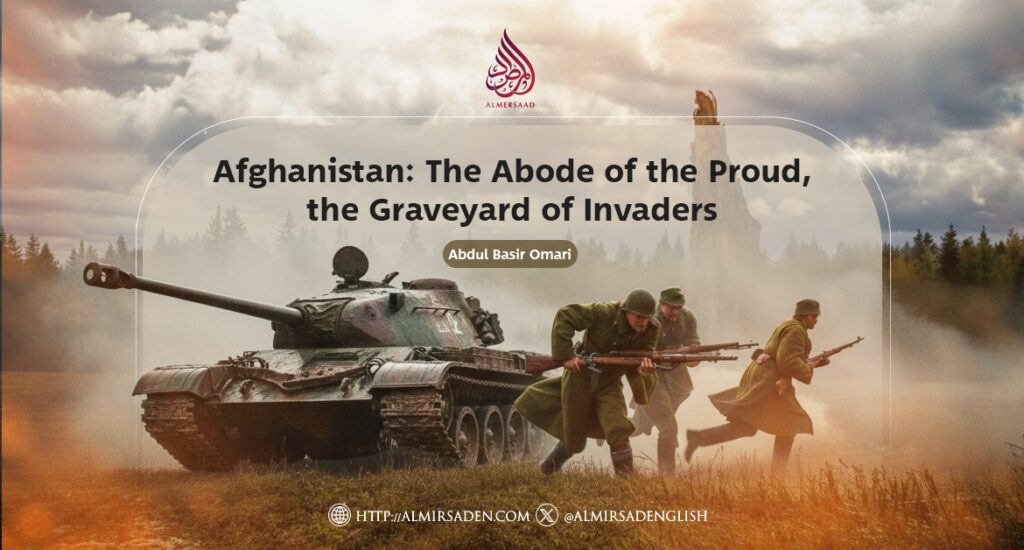
One of these oppressors was the occupying force of the Soviet Union, which invaded Afghanistan. After numerous battles and acts of jihad, on the 26th of Jaddi, they suffered a humiliating defeat in the trenches and were forced to retreat in disgrace. Today marks the completion of 37 years since that blessed day.