
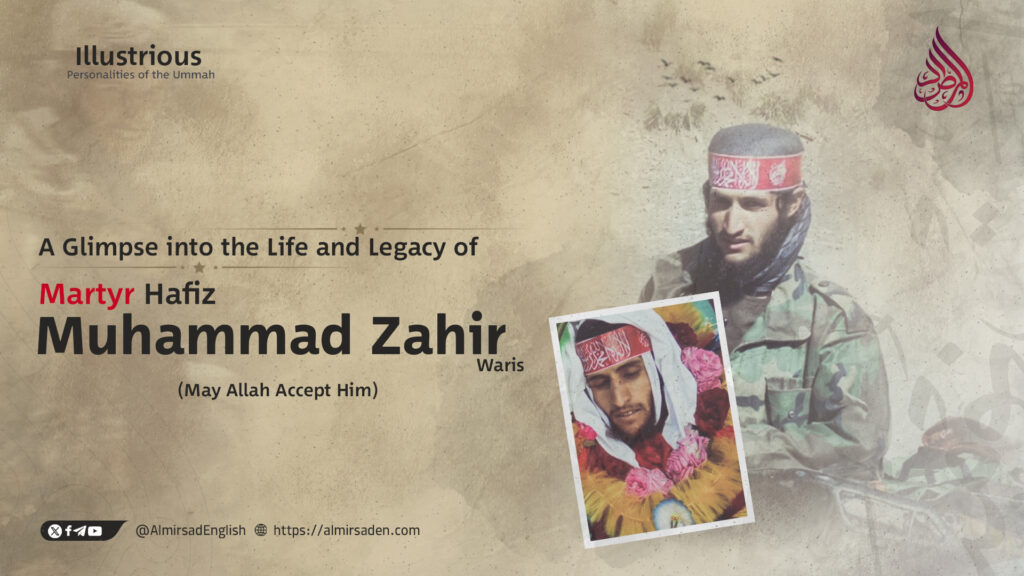
In the darkest nights of our time, he stood as a clear and steady light, a verse composed in the language of courage, a dignified man shaped by the noble character of the Prophet. He was a reflection of purity of conscience and a calm, sheltering presence along the path of martyrdom, a path upon which a nation scatters its flowers of pride. Martyr Saeed Hafiz Muhammad Zahir Waris, the son of Fazal Rabbi and a native of Qala Abdul Wahab village in the Nirkh district of Maidan Wardak, was born on 24/3/1374 (Solar Hijri) in a household known for its devotion and commitment to jihad.
Waris, may Allah accept him, was still a young boy when he began his first religious and doctrinal lessons under the guidance of the village imam. He later enrolled at Dr. Abdul Wakil High School, and after completing his studies there, he went on to memorize the Holy Qur’an at the Umar Farooq Seminary in the village of Tokarak.
His brother, Muhammad Haroon, recalls that the oppression carried out by the foreign occupiers and their internal militias in Maidan Wardak had reached unbearable levels. Their own family did not escape these hardships. They were repeatedly threatened and pressured by local militias, who warned them to abandon their home and village.
Our brother was a Hafiz of the Qur’an and a devoted follower of the path of faith. Because of this, hardship settled over our household like a heavy cloud. Even our elderly father, with his white beard and gentle nature, was subjected to humiliating and harsh words. The forces of the former republic showed little respect for religious families and treated them with cruelty and disdain.
As the pressure around him grew, obstacles began to pile up on my brother’s path to education. Eventually he was forced to abandon his studies. In 1392 (Solar Hijri), he lifted the banner of faith and honor on the battlefield and joined the struggle. He spent the remainder of his life on the frontlines, waging an unrelenting jihad for the elevation of Allah’s religion and the liberation of his homeland.
He took part in many battles and distinguished himself with dedication and skill. Along with his combat experience, he became a highly capable mines specialist and served as the deputy of the Red Unit. He offered firm and unwavering resistance against both internal and external enemies in his district, always present in every ambush and attack that took place in the region.
He also fought bravely against the Daeshi Khawarij of his time. On several occasions, he traveled with his comrades to Nangarhar as part of their assigned formations. He would often recount one particular incident. During a battle, a Daeshi fighter was captured alive. The man was a Hafiz of the Holy Qur’an. “Because I am also a Hafiz,” he would say, “my heart could not bear to harm him.” When we contacted our commanders and explained the situation, we asked for guidance. The response was an instruction to carry out the execution. Two days later, when we returned to where the body lay, an overpowering stench rose from the corpse. Yet the bodies of our own martyred brothers, who would sometimes remain on the battlefield for months under the blazing sun, never decayed nor produced any smell. That incident, he said, strengthened our faith beyond measure. From that day forward, I no longer hesitated in such moments.
When he returned to his province, on 27/3/1396 (Solar Hijri), during the blessed month of Ramadan, he conducted a planned operation against internal militias in the center of Maidan Shahr. The operation claimed the lives of many enemies of the religion, and there he himself attained martyrdom.
His brother, Muhammad Javid, describes the heartbreak of that day. When we brought the body of Martyr Waris, may Allah accept him, back to our home, the scene felt heavier than anything we could imagine, a moment more overwhelming than the Day of Resurrection. The grief of our family and the surrounding community was immense. The cries of women and children tore at our hearts. Yet the most painful moment came during the burial preparations, when a mullah turned to me and said, “Check his pockets, for he did not speak at the moment of his martyrdom.” With a trembling heart, I reached into the pockets of my fallen brother while many people stood around us. Inside were fifty Afghanis. Along with them, on a small slip of paper, he had recorded a debt of one hundred and fifty Afghanis and the names of several shopkeepers. That small, fragile note, and the poverty it revealed, still brings deep sorrow to every member of our family. His loss was a wound of its own, but those empty pockets are something I will remember for the rest of my life.
We keep the memory of his courage, his faith, and his sacrifice alive in our hearts. Yet within that single piece of paper and those few Afghanis lies a bitter story of hardship and struggle. He was a Hafiz of the Qur’an who lived with contentment despite all his difficulties. Even in the final hours of his life, he took care to write down the small debts he owed to the shopkeepers, as if ensuring that nothing entrusted to him would remain unsettled.